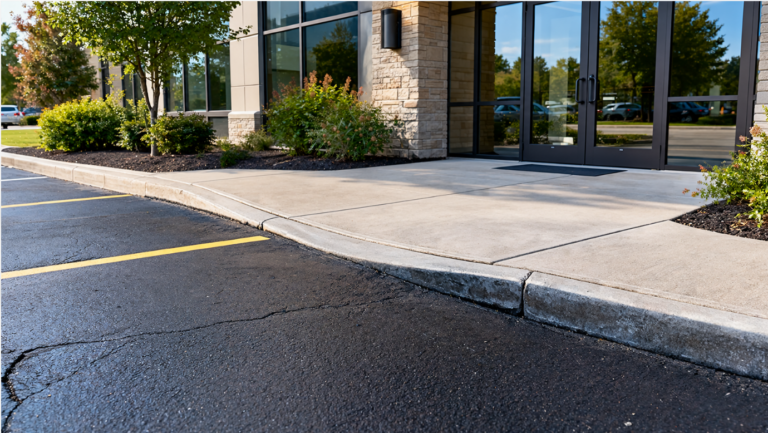
Building entrances are among the most frequently used areas of a commercial property. Customers, employees, residents, delivery vehicles, and maintenance crews regularly travel through these spaces, placing repeated stress on the pavement surrounding entrances, sidewalks, and parking areas.
While a parking lot may remain in relatively good condition for years, the pavement closest to a building entrance can begin showing cracks, settlement, potholes, or other signs of deterioration much sooner.
These problems are not always caused by heavy traffic alone. Drainage, pavement design, construction methods, and the connection between asphalt and concrete can all affect how entrance areas perform.
Understanding the factors that influence commercial entrance paving can help property owners plan improvements that protect pavement durability while maintaining safe and convenient access.
Why Does Pavement Deteriorate Near Commercial Entrances?
One of the most common questions is, why does pavement deteriorate near commercial entrances?
Entrance areas often experience concentrated traffic and repeated changes in vehicle movement.
Drivers slow down, turn into parking spaces, stop to drop off passengers, and accelerate away. Delivery vehicles may park near entrances while unloading materials, while maintenance trucks repeatedly follow the same access routes.
These movements create different stresses than vehicles traveling straight through a parking lot.
Braking and turning can place additional forces on asphalt, while repeated loading can contribute to settlement or cracking when the underlying pavement structure is insufficient.
Over time, these conditions may create a need for high traffic pavement repair.
Entrances Experience More Than Vehicle Traffic
Commercial building entrances also need to accommodate pedestrians, wheelchairs, strollers, carts, and delivery equipment.
The pavement surrounding these areas often connects parking spaces, drive lanes, sidewalks, ramps, and building entrances.
Because several surfaces meet in a relatively small area, even minor deterioration can become noticeable.
For example, settlement near a curb ramp may create an uneven transition between the parking lot and sidewalk.
Cracking along the edge of a concrete walkway may also allow water to enter the supporting materials beneath the pavement.
Property managers should evaluate these areas as part of a complete entrance system rather than treating each surface independently.
Should Building Entrances Use Asphalt or Concrete?
Property owners frequently ask, should building entrances use asphalt or concrete?
Both materials can perform well when properly designed and installed, but they are often suited to different applications.
Asphalt is commonly used for parking lots, drive lanes, and vehicle circulation areas because it provides a durable driving surface and can be installed efficiently across larger spaces.
Concrete is frequently used for sidewalks, curbs, pedestrian ramps, loading areas, and other locations where dimensional stability and resistance to concentrated loads are important.
For example, a commercial entrance may use asphalt for vehicle access while incorporating concrete sidewalks and curbs to guide pedestrian movement.
In areas where heavy vehicles regularly stop or maneuver, concrete may be considered as part of the pavement design.
The appropriate combination depends on traffic, drainage, accessibility, and the property’s layout.
Pavement Transitions Deserve Special Attention
One of the most vulnerable locations near a building entrance is the point where asphalt meets concrete.
These commercial pavement transitions occur around sidewalks, curbs, loading areas, ramps, and building approaches.
Asphalt and concrete have different material properties and may respond differently to temperature changes, loading, and movement.
If the supporting base is unstable or the transition is poorly constructed, gaps, cracks, or uneven surfaces may develop.
Water can also enter openings along these joints and affect the materials beneath the pavement.
Proper construction and maintenance of these transitions can help reduce deterioration and preserve a smoother connection between surfaces.
Drainage Problems Can Shorten Pavement Life
Water is a major factor in pavement performance.
Building entrances often contain multiple changes in elevation, including curbs, ramps, sidewalks, and parking lot slopes.
If these features are not graded properly, water may collect near the entrance or flow toward the building.
Standing water can enter existing cracks and weaken the aggregate base beneath asphalt pavement.
During colder weather, moisture within pavement cracks and supporting materials can contribute to deterioration associated with freezing and thawing.
When planning asphalt entrance repair, property owners should evaluate drainage rather than focusing only on the visible pavement damage.
Correcting the surface without addressing recurring water problems may allow deterioration to return.
Proper Base Preparation Is Essential
The durability of entrance pavement depends heavily on the materials beneath the surface.
Asphalt and concrete both require appropriate support from the underlying base and subgrade.
If these materials are poorly compacted, unstable, or affected by water, the pavement above may settle or crack.
This is particularly important around commercial entrances where construction may involve several pavement materials installed at different times.
Proper site preparation helps create consistent support and reduces the likelihood of uneven settlement.
For building entrance concrete installation, contractors should evaluate the supporting soil, drainage conditions, intended loads, and required elevations before placing new concrete.
The same principles apply to asphalt construction.
Heavy Vehicles Require Additional Consideration
Not every entrance receives the same traffic.
An office building may primarily serve passenger vehicles, while a retail property may regularly accommodate delivery trucks.
Apartment communities may also experience moving trucks, maintenance equipment, garbage trucks, and emergency vehicles.
These heavier vehicles can place substantial loads on pavement, particularly when turning or stopping.
Areas exposed to repeated heavy traffic may require additional pavement thickness, stronger base construction, or a different material selection.
Effective commercial entrance paving should reflect the vehicles that actually use the property rather than relying on a single design for every location.
Recognize Early Signs of Pavement Failure
Property managers should inspect entrance areas regularly because small defects can become more serious when exposed to concentrated traffic.
Common warning signs include cracking along curbs, potholes near drive lanes, uneven pavement transitions, standing water, settlement, and broken concrete edges.
Repeated deterioration around previous patches can also indicate that the underlying problem has not been fully corrected.
Documenting these conditions helps property managers determine whether maintenance is sufficient or whether more extensive repairs are necessary.
Early inspections are especially useful before winter, when existing cracks and drainage problems may become more difficult to manage.
Choose Repairs Based on the Cause
Not every damaged entrance requires complete reconstruction.
Minor asphalt cracking may be appropriate for preventive maintenance when the pavement remains structurally sound.
Localized potholes or failed sections may require patching or full depth repairs.
More extensive deterioration involving weak base materials, settlement, or drainage problems may require removing and rebuilding the affected pavement.
Concrete repairs may involve replacing damaged sidewalk panels, curbs, or other entrance features.
Professional high traffic pavement repair should address the underlying cause rather than simply covering visible damage.
This approach can help property owners avoid repeated repairs in the same location.
Coordinate Asphalt and Concrete Improvements
Commercial entrance projects often involve several connected surfaces.
Replacing a damaged curb may affect the adjoining asphalt. Reconstructing a sidewalk may require adjusting nearby pavement elevations. Drainage improvements may also influence the final grading.
Coordinating these improvements can create a more consistent finished surface and reduce the likelihood that recently installed pavement must be disturbed later.
For larger properties, entrance improvements may be incorporated into a broader capital maintenance plan.
This allows property managers to coordinate asphalt entrance repair, concrete replacement, drainage work, and other pavement improvements within a practical construction schedule.
Maintain Safe and Accessible Entrances
Durability is important, but entrance pavement must also remain functional for everyone using the property.
Uneven surfaces, damaged curb ramps, standing water, and deteriorated sidewalks can create challenges for pedestrians and people using mobility devices.
Property managers should consider applicable accessibility requirements when repairing or reconstructing entrance areas.
Proper slopes, smooth transitions, drainage, and clear pedestrian routes should be evaluated during project planning.
Well designed entrances support both long term pavement performance and convenient access to the building.
Protect Your Property With Proactive Entrance Maintenance
Commercial entrances experience a combination of vehicle loads, pedestrian activity, drainage challenges, and transitions between different pavement materials.
Because these conditions are concentrated in relatively small areas, entrance pavement deserves additional attention during inspections and maintenance planning.
Proper base preparation, appropriate material selection, effective drainage, and timely repairs can help extend pavement service life and reduce recurring problems.
If your commercial property has cracking, settlement, potholes, damaged curbs, or deteriorating pavement near building entrances, Vandalia Blacktop & Sealcoating Inc. can evaluate the affected areas and recommend appropriate improvements. From commercial entrance paving and asphalt entrance repair to building entrance concrete installation, contact us to get started.