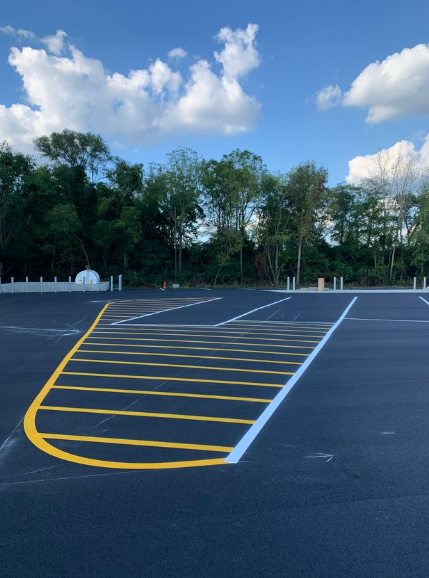
Self-storage facility paving needs a strong base and a thicker pavement section in the main drive aisles and turning areas, because moving trucks and trailers make tight, slow turns that twist and scuff asphalt. Good drainage, wide enough aisles for large vehicles, and a steady maintenance plan keep a storage site smooth and easy for customers to use.
A storage facility looks simple from above: rows of buildings with lanes between them. In practice, the pavement takes a beating that ordinary parking lots never see. Renters back box trucks up to unit doors, swing trailers around building ends and stop in the same spots again and again. Here is how to plan and care for pavement that holds up to that kind of use.
Why Storage Sites Wear Differently
Most parking lots carry cars that pull in, park and leave. Storage sites carry a mix of passenger vehicles, pickup trucks, rental moving trucks, trailers and sometimes RVs or boats. Many of those drivers are unfamiliar with the vehicle they are steering.
That creates three kinds of stress:
- Turning stress. Slow, sharp turns with heavy vehicles twist the asphalt surface. You will often see scuffing, raveling or shoving at the ends of buildings.
- Standing loads. Trucks parked at unit doors for loading put concentrated weight in the same narrow strips day after day.
- Repeated tracks. Traffic follows the same paths down each aisle, which can lead to ruts in the wheel paths if the pavement is too thin.
Understanding where these stresses land helps you decide where to invest in thicker pavement and where standard sections will do.
Designing Drive Aisles for Large Vehicles
Aisle width affects both customer experience and pavement life. When aisles are tight, drivers make multi-point turns, run over edges and clip curbs. Each of those moves wears the pavement faster.
Plan Around the Largest Vehicle
Think about the biggest vehicles your facility allows, such as large rental trucks or vehicles towing trailers. Turning areas at the ends of buildings should give those vehicles room to swing without backing up repeatedly.
Check Fire Access Requirements
Fire departments generally need clear access routes for their apparatus, and those requirements can affect aisle width, turning radius and pavement strength. Requirements vary, so confirm them with your local fire department and city or township before design is finalized.
Keep the Layout Readable
Clear directional arrows, building numbers and one-way markings reduce wrong turns and awkward maneuvers. Our parking lot striping team can lay out pavement markings that keep traffic flowing in a predictable pattern.
Building a Base That Can Take It
Heavy, slow-moving traffic is hard on any pavement, but it is especially hard on a weak base. A storage facility should be built on a well-compacted base designed for truck loads, with soft subgrade areas corrected before paving.
Turning areas, entrance lanes and the main circulation route usually deserve a thicker section than lightly used side aisles. For more on matching thickness to traffic, read choosing asphalt thickness for residential driveways, parking lots and heavy traffic areas.
Some owners use concrete in the hardest-hit spots, such as the gate area or a dumpster pad. Placing concrete where loads are heaviest can help the surrounding asphalt stay in good shape.
Drainage Between Long Rows of Buildings
Storage buildings shed a lot of roof water directly onto the pavement. With long rows of roofs and few green spaces, runoff can collect fast. If it has nowhere to go, water pools along building fronts and soaks into the base.
Good storage site design slopes each aisle toward planned collection points, such as a center swale or catch basins. Downspouts should discharge where water can move away rather than straight onto a low spot. Standing water in front of unit doors also annoys customers and becomes ice in winter.
Our drainage and site preparation work covers grading, catch basins and base preparation so water leaves the site instead of sitting on it.
Maintenance That Keeps a Storage Site Smooth
A storage facility is open long hours and often runs with a small staff, so maintenance needs to be predictable and easy to schedule.
- Inspect turning areas regularly. Look for scuffing, raveling and early cracks at building ends and the entrance.
- Seal cracks promptly. Crack sealing is typically done spring through fall and keeps water out of the base.
- Sealcoat on a schedule. Sealcoating in late spring through early fall protects the surface from sun and spills.
- Patch damage before it spreads. Hot mix repairs are done roughly mid-April through early December. Winter potholes can be filled with cold patch as a temporary fix.
- Refresh markings. Faded arrows and building numbers lead to confused drivers and more bad turns.
Work can usually be phased one aisle at a time so customers keep access to their units. Let renters know ahead of time which rows will be closed and when.
Frequently Asked Questions
Should a storage facility use asphalt or concrete?
Most storage sites use asphalt for drive aisles because it is economical and easy to repair, with concrete in select high-stress spots. The best mix depends on traffic and budget.
Why is the pavement at the ends of my buildings breaking up?
Those are turning areas, where heavy vehicles twist the surface. A thicker section or targeted repairs in those spots usually helps.
Can you pave without closing the whole facility?
Yes. Work is commonly phased by aisle or section so renters keep access, with clear notice ahead of time.
If your storage site is showing wear at the turns or holding water along the buildings, it is worth a closer look before small problems grow. Vandalia Blacktop & Sealcoating has handled commercial asphalt paving for Miami Valley properties since 1975, from Vandalia to Miamisburg. Call (937) 454-0571 or contact us to schedule an evaluation.