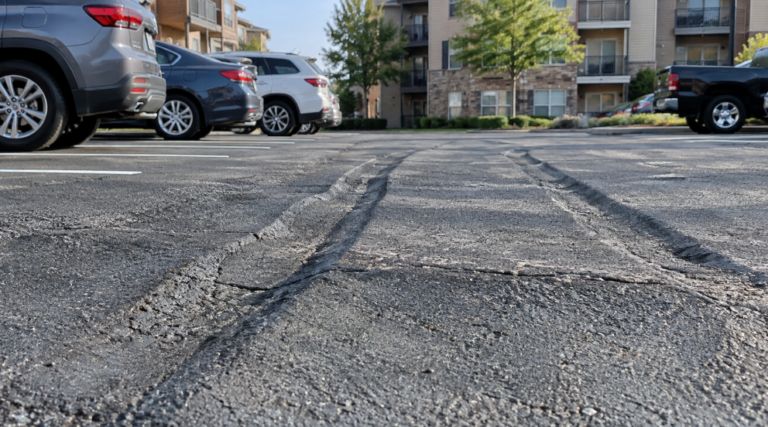
If you have noticed long depressions forming where vehicle tires repeatedly travel through a parking lot, you are probably looking at asphalt rutting. These sunken wheel paths may start as a minor appearance issue, but they can eventually interfere with drainage, create uneven driving surfaces, and signal deeper problems within the pavement.
For apartment owners and commercial property managers, identifying the cause of apartment parking lot asphalt damage early can make the difference between a targeted repair and a much larger reconstruction project. Rutting can develop because of heavy traffic, inadequate pavement thickness, weak underlying materials, improper compaction, or drainage problems.
Understanding why asphalt ruts form and how they should be repaired can help property managers protect their pavement investment and plan maintenance more effectively.
Why Are Tire Ruts Forming in My Parking Lot?
A common question from property managers is, why are tire ruts forming in my parking lot?
Rutting occurs when pavement permanently deforms under repeated vehicle loads. Instead of returning to its original shape after vehicles pass, part of the pavement structure gradually compresses or shifts.
The result is a depression that follows the path of vehicle tires.
Rutting is particularly common in locations that experience repeated heavy loads, including:
- Parking lot entrances
- Drive lanes
- Loading areas
- Dumpster approaches
- Delivery routes
- Bus loading areas
Understanding exactly which pavement layer is failing is important because different types of rutting require different repair strategies.
Heavy Vehicles Can Accelerate Pavement Deformation
Commercial parking lots are often used by vehicles much heavier than passenger cars. Garbage trucks, delivery vehicles, moving trucks, buses, and emergency vehicles can place considerable stress on pavement.
The problem becomes greater when heavy vehicles repeatedly follow the same route.
Apartment communities provide a good example. Garbage trucks may enter the property several times each week and travel along nearly identical paths. Delivery vehicles and moving trucks may also concentrate their traffic on the same drive lanes.
If those areas were not designed for heavier loads, commercial pavement deformation can develop much faster than expected.
A properly designed pavement system accounts for the type and frequency of traffic expected throughout the property.
Weak Base Materials Can Cause Asphalt to Sink
Not every rutting problem originates in the asphalt surface.
Sometimes the pavement is sinking because the aggregate base or soil underneath it is compressing.
Property managers often ask, what causes commercial asphalt to sink?
Possible causes include:
- Inadequate base thickness
- Poor subgrade preparation
- Insufficient compaction
- Unstable soil
- Water infiltration
- Unexpectedly heavy traffic
When the foundation moves, the asphalt above it moves too.
Simply adding new asphalt over an unstable foundation may temporarily hide the problem without correcting its cause. Proper diagnosis is essential before choosing an asphalt rutting repair method.
Poor Drainage Can Make Rutting Worse
Water can significantly reduce the structural performance of pavement when it reaches vulnerable layers beneath the asphalt.
Cracks, failed pavement edges, standing water, and inadequate drainage can allow moisture to reach the aggregate base or subgrade. Saturated supporting material may lose strength, increasing the likelihood of settlement and deformation under traffic.
Ruts can then create another drainage problem by collecting rainwater.
This cycle allows water to remain on the pavement longer, potentially accelerating deterioration. Maintaining drainage systems and repairing cracks early are therefore important parts of preventing rutting.
Asphalt Mix and Compaction Matter
Rutting can also occur within the asphalt layer itself.
Asphalt must be designed and installed to withstand anticipated traffic and environmental conditions. A pavement mixture that cannot adequately resist repeated loading may gradually move under traffic, particularly during hot weather when asphalt becomes more flexible.
Compaction during installation is equally important. Proper compaction creates a dense pavement structure capable of resisting traffic loads and limiting water infiltration.
Quality installation therefore plays an important role in preventing future parking lot wheel rut repair.
Can Asphalt Rutting Be Repaired?
Yes, but the appropriate repair depends on what caused the rutting.
For shallow surface deformation where the underlying pavement remains structurally sound, localized repairs or milling and resurfacing may be appropriate.
Deeper structural rutting requires a different approach. The damaged asphalt may need to be removed so contractors can evaluate and repair the aggregate base or subgrade before installing new pavement.
Potential asphalt rutting repair options include:
- Localized asphalt patching
- Milling and resurfacing
- Full depth pavement repair
- Base reconstruction
- Drainage improvements
A professional pavement evaluation helps determine whether the damage is limited to the asphalt or extends deeper into the pavement structure.
High Traffic Areas May Need Stronger Pavement
One of the best ways to reduce future rutting is to design pavement according to how each part of the property will actually be used.
Not every area experiences the same loads.
Parking stalls primarily support passenger vehicles, while drive lanes experience continuous movement. Dumpster approaches and loading areas may regularly support large trucks.
These high stress areas may require additional pavement thickness, stronger base construction, or other heavy traffic asphalt repair and design strategies.
For some extremely demanding locations, such as dumpster pads, concrete may be a better long term solution because of its ability to withstand concentrated heavy loads.
Rutting Can Create Safety and Maintenance Problems
Ruts should not be ignored simply because vehicles can still drive across them.
As depressions deepen, they may collect water and interfere with drainage. Uneven pavement can also become uncomfortable for drivers and more difficult for pedestrians to navigate.
During Ohio winters, water sitting in wheel ruts may freeze, creating additional concerns for vehicles and pedestrians.
Rutting can also make snow removal more difficult and accelerate deterioration around already damaged areas.
Addressing the problem early helps prevent these secondary issues.
Regular Inspections Help Catch Rutting Early
Property managers should include rutting in routine parking lot inspections.
Watch for:
- Visible wheel depressions
- Standing water in drive lanes
- Raised asphalt along the edges of wheel paths
- Cracking around depressed pavement
- Settlement near drains
- Deformation near loading areas and dumpster enclosures
Documenting these conditions makes it easier to determine whether deterioration is progressing.
Early evaluation also provides more options for repair before structural damage becomes widespread.
Choosing the Right Repair Strategy
There is no universal solution for asphalt rutting. Repairing only the visible surface without determining why it moved can lead to recurring problems.
An experienced asphalt contractor should evaluate the pavement structure, traffic patterns, drainage, and base conditions before recommending repairs.
For apartment communities and commercial properties, this is particularly important because different areas of the parking lot may require different solutions.
A parking stall with minor deformation may need a relatively simple repair, while a heavily traveled garbage truck route could require reconstruction designed specifically for repeated heavy loads.
Effective heavy traffic asphalt repair addresses the underlying cause rather than simply improving appearance.
Protecting Your Parking Lot for the Long Term
Rutting is often a sign that part of the pavement system is experiencing more stress than it can effectively support. Heavy vehicles, insufficient pavement structure, poor drainage, weak subgrade conditions, and installation problems can all contribute.
The sooner these conditions are identified, the easier it becomes to develop an appropriate repair strategy.
Preventive maintenance also remains important. Keeping cracks sealed, maintaining drainage, inspecting high traffic areas, and addressing isolated pavement failures can help protect surrounding asphalt and reduce the likelihood of larger problems.
If you are seeing tire depressions, sinking pavement, or other signs of commercial pavement deformation, Vandalia Blacktop & Sealcoating Inc. can evaluate the damage and determine the right approach for your property. From localized asphalt repairs to larger commercial paving projects, contact us to get started.