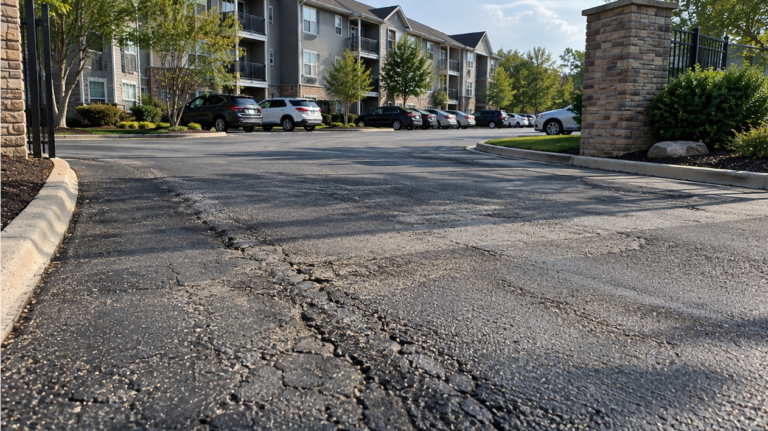
Walk through an apartment community and you may notice that the pavement near the entrance looks noticeably worse than the parking spaces farther inside the property. Cracks, depressions, worn surfaces, potholes, and tire ruts frequently appear at entrances first.
This pattern is not unusual. Apartment parking lot entrances experience some of the highest traffic concentrations anywhere on the property. Nearly every resident, visitor, delivery driver, maintenance vehicle, and garbage truck passes through the same relatively small section of pavement.
For property managers, understanding the causes of parking lot entrance deterioration makes it easier to identify problems early and plan repairs before damage spreads into surrounding pavement.
Why Does Asphalt Fail at Parking Lot Entrances?
A common question from property managers is, why does asphalt fail at parking lot entrances?
The simplest explanation is concentrated traffic.
A parking space might support a few vehicle movements each day. The main entrance may experience hundreds of vehicle movements as residents leave and return, visitors arrive, and service vehicles access the property.
That repeated loading places considerably more stress on the pavement.
Entrances also experience braking, acceleration, and turning movements. Instead of simply traveling straight across the asphalt, vehicles frequently slow down, stop, turn, and accelerate. These movements increase stress on the pavement and can contribute to surface wear and deformation.
Over time, high traffic asphalt repair may become necessary even while less traveled areas of the parking lot remain in relatively good condition.
Heavy Vehicles Increase the Stress
Passenger cars are only part of the traffic entering an apartment community.
Apartment parking lots may regularly accommodate:
- Garbage trucks
- Moving trucks
- Delivery vehicles
- Emergency vehicles
- Landscaping equipment
- Maintenance vehicles
- Utility trucks
These vehicles can be substantially heavier than passenger cars.
If they repeatedly follow the same entrance and drive lane, the pavement in those areas receives concentrated loading throughout the year. Garbage trucks can be particularly demanding because they may stop, turn, and accelerate while carrying significant weight.
This repeated heavy traffic can contribute to rutting, cracking, and structural deterioration.
Why Do Apartment Entrances Develop Cracks and Ruts?
Another common question is, why do apartment entrances develop cracks and ruts?
Rutting develops when pavement permanently deforms beneath repeated wheel loads. Cracking can develop for several reasons, including pavement aging, traffic stress, weak supporting materials, water infiltration, and movement in the underlying base.
Entrance areas can experience several of these conditions simultaneously.
For example, a heavily traveled entrance with poor drainage may develop cracks that allow additional water into the pavement. If moisture weakens the base, repeated vehicle loads can cause further movement.
What begins as relatively minor apartment parking lot asphalt damage can gradually become a larger structural problem.
Turning and Braking Put Extra Stress on Asphalt
Vehicle movement matters just as much as vehicle weight.
At apartment entrances, drivers frequently brake before entering a public roadway. Vehicles entering the property may slow sharply before making a turn.
These movements create forces that differ from vehicles traveling steadily across a straight section of pavement.
Heavy vehicles turning at low speeds can be particularly demanding on asphalt. Over time, these repeated movements may contribute to surface distortion and wear.
Good pavement design accounts for these traffic patterns, especially in areas expected to handle regular commercial vehicles.
Water Can Accelerate Entrance Deterioration
Traffic is not the only concern.
Entrances are often located near curbs, sidewalks, landscaped areas, storm drains, and public streets. These transitions can create complicated drainage patterns.
If water collects near the entrance or enters through cracks, it can reach the aggregate base beneath the asphalt. Moisture can weaken supporting materials and contribute to settlement and pavement movement.
Ohio’s seasonal temperature changes can add additional stress when moisture enters cracks and experiences repeated freezing and thawing.
Drainage should therefore be evaluated whenever apartment parking lot entrance repair is being considered.
Transitions Between Pavement Areas Can Become Weak Points
The entrance to an apartment community frequently connects private pavement with a public roadway, concrete gutter, curb, or previously repaired asphalt.
These transitions can become vulnerable areas if the adjoining surfaces move differently or water enters along the joint.
Utility work may also affect entrances because water, sewer, gas, electrical, or communication lines frequently cross access drives. Previous excavation can create another potential weak point if the trench was not properly restored.
A thorough pavement inspection should consider what is happening below the surface as well as the visible damage.
How Can Property Managers Prevent Entrance Pavement Damage?
Property managers often ask, how can property managers prevent entrance pavement damage?
It begins with regular inspections.
Because entrances experience greater stress, they should receive particular attention during routine pavement evaluations. Managers should watch for early warning signs such as:
- Small cracks
- Wheel ruts
- Depressions
- Standing water
- Edge deterioration
- Loose aggregate
- Pothole formation
- Settlement around drains or utilities
Catching these problems early may allow for more targeted property management asphalt repairs before deterioration spreads.
Crack sealing, drainage improvements, localized patching, and other preventive maintenance can help protect pavement when performed at the appropriate stage.
Repairs Should Address the Cause
A damaged entrance should not automatically receive the same repair as every other pavement problem.
If deterioration is limited to the asphalt surface, localized repair or resurfacing may be appropriate. If the pavement is sinking because the aggregate base has failed, deeper reconstruction may be necessary.
Similarly, repairing asphalt without correcting a drainage problem can allow the damage to return.
Effective commercial pavement repair begins with identifying why the pavement failed.
Contractors may evaluate traffic patterns, pavement thickness, base conditions, drainage, previous utility work, and the types of vehicles using the property before recommending a solution.
High Traffic Areas May Need Different Pavement Designs
One of the most important lessons for property managers is that every part of a parking lot does not experience the same demands.
Parking stalls primarily support stationary passenger vehicles. Main drive lanes experience repeated traffic. Entrances may experience nearly every vehicle that accesses the property.
For that reason, high traffic areas may require pavement structures designed specifically for heavier use.
During reconstruction or major parking lot improvements, an experienced contractor can evaluate whether the entrance requires additional structural support compared with lower traffic sections.
Make Entrances Part of Your Maintenance Plan
Apartment parking lot entrances may represent a relatively small portion of the property’s total pavement, but their condition can have an outsized impact on daily operations.
A damaged entrance affects residents, visitors, deliveries, maintenance crews, and emergency access. It can also create a poor first impression before someone reaches the rest of the property.
Including entrances in a long term pavement maintenance plan allows property managers to budget for repairs instead of waiting for widespread failure.
Routine inspections, prompt crack repair, good drainage, and appropriate high traffic asphalt repair can all help extend pavement life.
If your apartment entrance is showing cracks, rutting, settlement, potholes, or other signs of deterioration, Vandalia Blacktop & Sealcoating Inc. can evaluate the problem and recommend the appropriate repair. From targeted apartment parking lot entrance repair to larger commercial paving projects, contact us to get started.