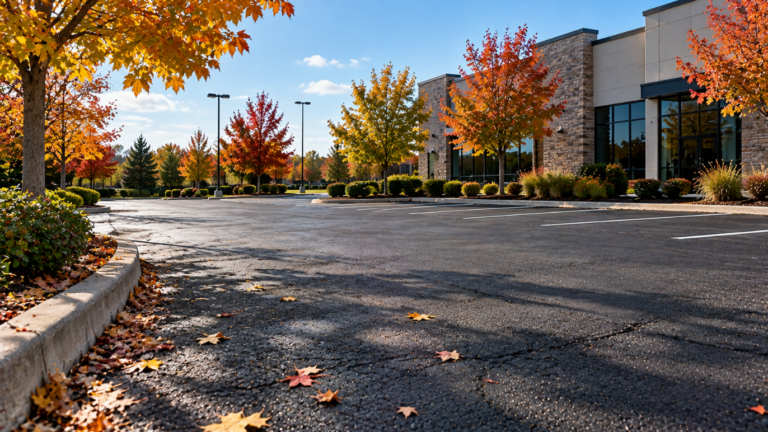
Fall often feels like the end of the paving season, but for property managers and commercial property owners, it can also be the beginning of next year’s pavement planning.
Before winter weather arrives, parking lots are still easy to inspect, existing damage is visible, and many property managers are beginning to develop budgets for the coming year. That combination makes fall an excellent time to evaluate asphalt conditions and decide which projects should become priorities during the next paving season.
Starting commercial asphalt project planning early gives businesses more time to evaluate pavement conditions, develop realistic budgets, coordinate construction, and avoid making major paving decisions only after problems become urgent.
Why Inspect Parking Lots in the Fall?
Property managers frequently ask, why inspect parking lots in the fall?
One advantage is visibility. Cracks, potholes, drainage problems, settlement, failed patches, and other pavement defects can be documented before snow, ice, and winter conditions make inspections more difficult.
Fall also provides an opportunity to see how the pavement performed through another year of traffic and weather. Areas that appeared relatively stable in spring may have developed new cracks, depressions, or surface deterioration during the warmer months.
A fall parking lot assessment can identify cracking, potholes, rutting, deteriorating edges, standing water, faded pavement markings, damaged curbs, and uneven surfaces.
Once those conditions are documented, property managers can separate immediate maintenance needs from larger projects that should be considered for next year’s capital budget.
When Should Businesses Start Planning Next Year’s Paving Project?
Another common question is, when should businesses start planning next year’s paving project?
For substantial work expected during the next paving season, fall is a practical time to begin.
Large commercial asphalt projects involve more than choosing a construction date. Property managers may need time to determine the scope, obtain estimates, secure internal approvals, coordinate with ownership, communicate with tenants, and decide whether construction should be divided into phases.
Early commercial paving planning gives decision makers time to work through those questions before construction needs become urgent.
It also provides an opportunity to identify related improvements that may make sense as part of the project, including concrete repairs, drainage corrections, catch basin work, and new parking lot striping.
Fall Assessments Can Improve Next Year’s Budget
One of the most useful reasons to evaluate pavement in the fall is financial planning.
Without a current pavement assessment, next year’s asphalt budget may be based primarily on previous spending or rough estimates. That can make it difficult to anticipate larger repairs.
A detailed property manager paving budget can instead reflect the actual condition of the property.
For example, one portion of a parking lot may remain structurally sound and require only maintenance. Another section may contain widespread cracking or settlement that requires more extensive repair.
Knowing those differences before budgets are finalized helps property managers determine where capital spending may be necessary and where preventive maintenance may still be appropriate.
Look Beyond Potholes
Potholes are easy to recognize, but they are only one sign of pavement deterioration.
Cracking patterns can provide clues about what is happening within the pavement structure. Settlement may indicate problems with the base or underlying soil. Standing water can point toward drainage or grading issues. Repeated deterioration around previous repairs may indicate that the underlying problem was never fully addressed.
A thorough fall parking lot assessment should examine the entire property, including entrances, intersections, loading areas, dumpster routes, parking spaces, tight corners, and heavily traveled drive lanes.
A qualified commercial asphalt contractor can help determine which problems are limited to the pavement surface and which may require deeper structural repairs.
Winter Can Expose Existing Weaknesses
Fall is also an important time to evaluate pavement because another winter is approaching.
When asphalt develops open cracks, water can enter the pavement and reach the materials beneath it. Seasonal freezing and thawing can contribute to additional movement and deterioration in pavement that is already compromised.
Property managers do not necessarily need to complete every major project before winter. Instead, a fall inspection can establish a clear picture of current conditions.
The property can then be evaluated again after winter if necessary. Comparing conditions can help determine which areas deteriorated and whether the planned scope should be adjusted before construction begins.
How Far Ahead Should Property Managers Schedule Asphalt Work?
Property managers often ask, how far ahead should property managers schedule asphalt work?
There is no single schedule that fits every property. The size and complexity of the project matter.
A small repair project may require relatively limited coordination. A complete parking lot resurfacing project may involve multiple construction phases, temporary parking arrangements, delivery schedules, tenant access, and traffic management.
Larger projects generally benefit from earlier planning.
Beginning the process during fall gives property managers time to define the project, develop a budget, and consider when construction will create the least disruption.
Early planning does not necessarily mean committing to a specific construction date immediately. It means understanding the likely scope before the paving season begins.
Apartment Communities Require Additional Coordination
Apartment complexes present a particular challenge because parking lots are continuously used by residents.
A large paving project may temporarily eliminate dozens of parking spaces or change how residents enter and exit the property.
Property managers need to consider where residents will park, how emergency vehicles will maintain access, whether garbage collection will be affected, and how work can be divided into manageable sections.
Phased construction can often reduce disruption.
For larger properties, fall is also a good time to consider whether a multi-year pavement plan would be useful. The most deteriorated sections can be prioritized while other areas receive maintenance until their scheduled improvements.
Evaluate Drainage Before Finalizing the Paving Scope
Drainage should be part of commercial asphalt project planning, not an afterthought.
If water repeatedly collects in certain sections of a parking lot, resurfacing alone may not solve the problem.
Standing water can be related to settlement, grading, catch basins, or surrounding drainage conditions. These issues should be evaluated before the paving scope is finalized.
Concrete curbs and sidewalks should also be inspected. If damaged concrete needs replacement, coordinating that work with the paving project can create a more efficient construction sequence.
The goal is to understand the entire paved area rather than treating the asphalt surface as an isolated system.
Decide What to Maintain, Repair, or Replace
One of the most important parts of pavement planning is determining which treatment fits each area.
Not every worn parking lot needs complete replacement.
Structurally sound pavement may remain a good candidate for preventive maintenance. Isolated failures may require localized full depth repairs. More extensive deterioration could indicate that resurfacing or reconstruction should be considered.
These distinctions have a major impact on commercial pavement budgeting.
A professional assessment can help property managers avoid both extremes: replacing pavement that can still be maintained or repeatedly patching areas where more substantial repairs are needed.
Use Fall to Build a Longer Term Pavement Plan
Next year’s paving project should ideally be part of a broader maintenance strategy.
Once the most immediate priorities are identified, property managers can begin looking several years ahead. One section may require major work next year while another may only need maintenance before eventually being resurfaced.
This longer view can help distribute large capital expenses across multiple budget cycles.
It can also make annual pavement decisions more predictable. Instead of waiting for visible failures to determine the next project, property managers have a working plan that can be updated as pavement conditions change.
Start Planning Before Pavement Problems Become Emergencies
Fall provides an opportunity to approach commercial paving proactively. Property managers can document pavement conditions, identify drainage and structural concerns, determine which areas deserve priority, and begin incorporating those projects into next year’s budget.
Early commercial paving planning also creates more time to coordinate construction schedules, communicate with tenants or residents, and determine whether a large project should be completed in phases.
If your commercial property or apartment community is showing cracking, potholes, settlement, drainage problems, or general pavement deterioration, Vandalia Blacktop & Sealcoating Inc. can evaluate the property and help you begin planning for next year’s asphalt work. Contact us to get started.