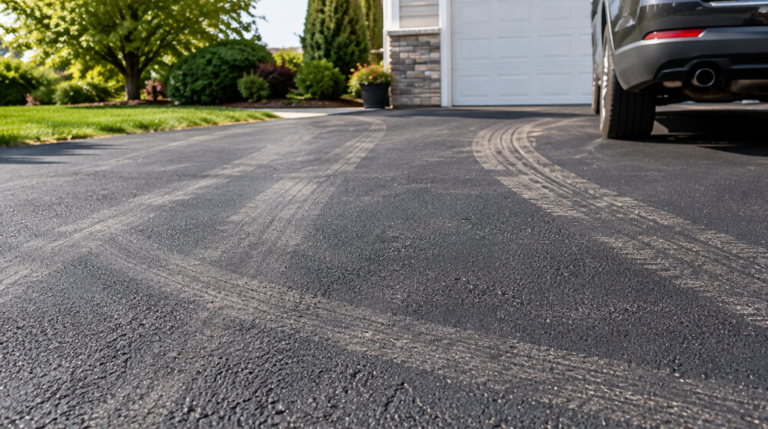
A freshly paved driveway or parking lot should look smooth, dark, and uniform, so discovering tire marks or scuffs shortly after installation can be concerning. This is especially common during hot summer weather, when a new asphalt surface is still relatively soft and temperatures are high.
Fortunately, new asphalt tire marks do not automatically mean something is wrong with the pavement. Asphalt remains flexible after installation, and summer heat can temporarily make the surface more susceptible to marks caused by turning tires, parked vehicles, and other concentrated loads.
Understanding asphalt curing in summer can help homeowners and property managers distinguish normal surface marks from signs that deserve professional attention.
Why Are Tires Leaving Marks on My New Driveway?
One of the first questions homeowners ask after noticing marks is, why are tires leaving marks on my new driveway?
The answer usually comes down to a combination of new pavement, heat, and tire movement.
Asphalt contains bitumen, commonly called asphalt binder, which holds the aggregate together. This binder gives asphalt its flexibility, but fresh pavement remains more susceptible to surface movement as it begins aging and hardening.
Hot weather increases that flexibility. Dark asphalt absorbs substantial solar energy, so the pavement surface can become considerably hotter than the surrounding air.
When a vehicle turns its steering wheel while stopped or moving very slowly, the tires can twist against the pavement. This concentrated friction may create visible scuffs, particularly on recently installed asphalt.
What Causes Asphalt Scuffing in Hot Weather?
Asphalt scuffing in hot weather typically happens when tire friction moves or disturbs a small amount of material at the pavement surface.
It is particularly noticeable when vehicles:
- Turn sharply at low speeds
- Turn their wheels while stationary
- Make repeated tight turns
- Park in the same location
- Maneuver on very hot pavement
These movements create lateral forces rather than the primarily downward forces associated with normal straight line driving.
On an older, hardened asphalt surface, these forces may leave little visible evidence. On new pavement during hot weather, they can create curved tire marks or minor surface scuffs.
Are Scuff Marks on New Asphalt Permanent?
Another common question is, are scuff marks on new asphalt permanent?
Minor surface scuffing is often primarily cosmetic and may become much less noticeable as the asphalt ages and normal traffic blends the surrounding surface.
Not every mark should be ignored, however.
Property owners should pay closer attention if tire movement creates:
- Deep depressions
- Loose or displaced asphalt
- Raised ridges
- Significant grooves
- Repeated deformation in wheel paths
- Areas that remain unusually soft
These symptoms may indicate something more substantial than ordinary surface scuffing. A paving professional can evaluate the area and determine whether the condition is cosmetic or requires attention.
How Long Is New Asphalt Vulnerable During Hot Weather?
There is no single period that applies to every installation.
So, how long is new asphalt vulnerable during hot weather?
Asphalt begins cooling and becoming usable relatively quickly after installation, but that does not mean the material has immediately reached the same condition it will have after months of exposure and use.
Temperature, asphalt mixture, pavement thickness, traffic, weather, and site conditions can all influence how a new surface behaves.
During especially hot weather, even pavement that has been in place for some time may become more flexible during the hottest part of the day.
This is why following the contractor’s recommendations after installation is an important part of residential asphalt care.
Tire Marks Do Not Necessarily Mean the Asphalt Was Installed Incorrectly
Seeing marks on an expensive new driveway can understandably make a homeowner question the installation.
Surface marks alone are not evidence of poor workmanship.
Minor tire scuffs may simply indicate that the pavement was exposed to turning forces while the surface was hot and relatively new. The more useful indicators of installation quality include proper grading, drainage, compaction, pavement thickness, base preparation, and overall structural performance.
The distinction between cosmetic scuffing and structural deformation is important.
A surface scuff changes the appearance of the pavement. Structural movement changes the pavement’s shape or ability to perform.
New Driveway Tire Marks Are Often Caused by Stationary Turning
One of the easiest ways to reduce new driveway tire marks is to avoid turning the steering wheel while the vehicle is completely stopped.
This behavior, sometimes called dry steering, forces the tire tread sideways against one small area of pavement.
Instead, allow the vehicle to move slightly before turning the steering wheel. Even slow forward or backward movement reduces the amount of twisting force concentrated on one spot.
This simple driving habit can be particularly helpful during the hottest summer days.
Heavy Vehicles Require Additional Care
Passenger vehicles are not the only concern for newly installed pavement.
Moving trucks, recreational vehicles, trailers, garbage trucks, delivery vehicles, and construction equipment can place substantially greater loads on asphalt.
For apartment communities and commercial properties, heavy vehicles may repeatedly travel through the same entrances and drive lanes.
A properly designed pavement structure should account for anticipated traffic. However, unnecessary heavy vehicle use on newly installed asphalt should still be avoided when possible, particularly until the contractor says the surface is ready.
Hot Weather Makes Asphalt More Flexible
Asphalt is designed to remain somewhat flexible throughout its service life. That flexibility allows pavement to tolerate traffic and changing environmental conditions without behaving like a completely rigid material.
Summer temperatures can increase that flexibility.
This does not mean properly installed asphalt should melt or fail whenever temperatures rise. It does mean that concentrated loads and aggressive turning movements can have a greater effect on hot pavement than they would during cooler conditions.
This relationship between temperature and pavement behavior explains why asphalt scuffing in hot weather is most noticeable during summer.
How to Care for New Asphalt During Summer
Good residential asphalt care begins immediately after installation.
Homeowners and property managers should follow the paving contractor’s instructions regarding when vehicles can begin using the pavement. Once the surface is open to traffic, sensible precautions can help protect its appearance.
Try to avoid stationary steering, extremely sharp turns, and unnecessary heavy loads during periods of intense heat. Heavy trailers, equipment, or other concentrated loads should also be managed carefully.
For apartment and commercial parking lots, property managers can coordinate deliveries and heavy service vehicles when practical while newly installed pavement is most vulnerable.
When Should You Call the Contractor?
Most minor tire marks do not require repair, but some conditions deserve a professional evaluation.
Contact your paving contractor if you notice deep rutting, significant depressions, widespread displacement, crumbling asphalt, drainage problems, or areas that continue deforming under ordinary passenger vehicle traffic.
Photos can also help document whether a condition is changing over time.
A professional inspection can determine whether you are seeing ordinary cosmetic scuffing or a pavement problem involving the asphalt mixture, base, compaction, or another component of the installation.
Protecting New Asphalt for the Long Term
New asphalt is an investment, and understanding how the material behaves makes it easier to protect that investment. Tire marks and light surface scuffs can be particularly noticeable during hot weather, but minor cosmetic marks are often part of the early life of a new asphalt surface rather than evidence of failure.
Proper installation remains the foundation of long term performance. A stable base, effective drainage, correct pavement design, quality compaction, and appropriate maintenance all contribute to durable asphalt.
If you are concerned about new asphalt tire marks, planning a new driveway, or need professional asphalt installation for a residential or commercial property, Vandalia Blacktop & Sealcoating Inc. can help you understand what your pavement needs and how to care for it. Contact us to get started.