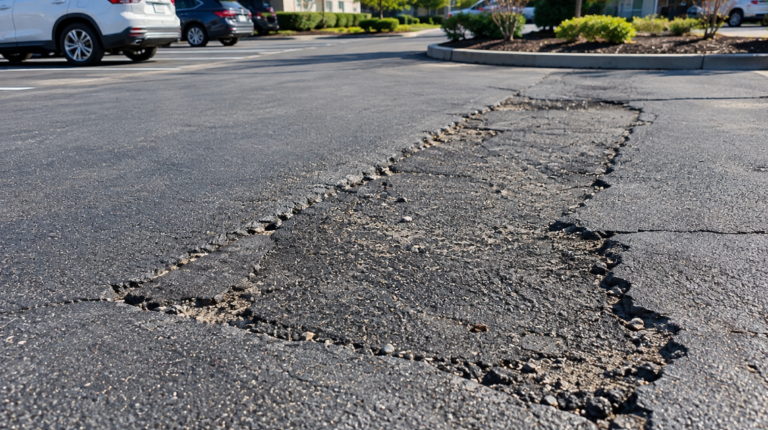
Utility work is sometimes unavoidable on commercial and residential properties. Water lines fail, sewer systems need repairs, electrical service gets upgraded, and new communications infrastructure may need to be installed. When those utilities run underneath a driveway or parking lot, crews often have to cut through existing asphalt to reach them.
The utility repair may solve the immediate problem, but opening the pavement also disrupts a structure that was originally designed and compacted as a continuous system. If the trench is not properly backfilled, compacted, and paved, the repaired area can eventually settle, crack, or separate from the surrounding asphalt.
For apartment owners, property managers, businesses, and homeowners, understanding proper asphalt utility cut repair can help prevent a necessary underground repair from turning into a recurring pavement problem.
Why Do Utility Cuts Become Weak Spots in Parking Lots?
Property managers often ask, why do utility cuts become weak spots in parking lots?
The answer begins with the way pavement is constructed.
A typical asphalt pavement system includes compacted soil, an aggregate base, and one or more asphalt layers. During initial construction, these materials are prepared and compacted to create a stable structure capable of supporting traffic.
Utility excavation cuts through these existing layers.
After the underground work is finished, contractors must essentially rebuild that section of pavement. If any part of the reconstructed area is weaker than the original pavement, traffic and weather can expose the difference over time.
That is why proper pavement trench repair involves much more than simply filling the hole and placing asphalt over it.
Why Does Asphalt Sink Around Utility Repairs?
Another common question is, why does asphalt sink around utility repairs?
Settlement often occurs because the material placed back into the trench was not compacted sufficiently or because the supporting material beneath the asphalt changed after excavation.
A trench may be several feet deep. Filling that entire excavation introduces a large volume of disturbed material that must be carefully replaced and compacted.
Potential causes of settlement include:
- Inadequate compaction
- Improper backfill materials
- Water infiltration
- Weak soil beneath the trench
- Poor drainage
- Insufficient aggregate base
- Heavy vehicle traffic
When supporting material settles, the asphalt patch around utilities moves downward with it.
The result may be a noticeable depression that collects water and creates an uneven driving surface.
Compaction Is Critical After Trenching
Proper compaction is one of the most important elements of utility excavation asphalt repair.
Rather than placing all backfill at once, suitable material generally needs to be installed and compacted according to the requirements of the project. The goal is to restore adequate support beneath the new pavement.
Poor compaction can leave voids within the reconstructed area. As vehicles repeatedly travel across the repair, the material may compress further, causing the pavement above it to sink.
This problem can be particularly noticeable in commercial parking lots where garbage trucks, delivery vehicles, and other heavy equipment repeatedly cross repaired utility trenches.
Water Can Accelerate Failure
Utility cuts also create new joints between existing pavement and replacement asphalt.
These joints deserve careful attention because they can become pathways for water.
Once moisture reaches the aggregate base or subgrade, it can weaken supporting materials and contribute to settlement, cracking, and pothole formation.
Ohio’s seasonal freeze and thaw conditions can place additional stress on areas where water has entered the pavement structure.
Good commercial pavement restoration therefore includes attention to drainage and the transition between existing and replacement pavement.
How Should Pavement Be Restored After Trenching?
Property owners frequently ask, how should pavement be restored after trenching?
The exact process depends on the depth of excavation, existing pavement structure, soil conditions, traffic loads, and requirements associated with the utility work.
A professional restoration process may involve:
- Evaluating the trench and surrounding pavement
- Using appropriate backfill materials
- Compacting supporting materials
- Reconstructing the aggregate base
- Preparing clean pavement edges
- Installing asphalt at an appropriate thickness
- Compacting the replacement asphalt
- Addressing joints between new and existing pavement
The objective is to rebuild the pavement structure rather than simply cover the excavation.
Heavy Traffic Can Reveal Weak Repairs
Commercial properties create additional challenges because repaired pavement may need to support substantial vehicle loads immediately after construction.
Apartment communities may regularly accommodate garbage trucks, moving trucks, delivery vehicles, maintenance equipment, and emergency vehicles.
Retail and industrial properties may experience even heavier commercial traffic.
When these vehicles repeatedly cross a poorly restored trench, weak supporting material can begin deforming.
A proper asphalt utility cut repair should therefore account for how the repaired area will actually be used.
Watch for Cracking Along the Repair
Cracking around a utility patch can be an early indication that the restored area is moving differently from the surrounding pavement.
Property managers should watch for:
- Cracks along patch edges
- Depressions over trenches
- Standing water
- Potholes near utility repairs
- Loose pavement edges
- Settlement around utility structures
These symptoms do not necessarily mean the entire parking lot is failing. The problem may be isolated to the previous excavation.
Early evaluation can help determine whether localized pavement trench repair is sufficient or whether deeper reconstruction is needed.
Utility Structures Can Create Additional Challenges
Utility work does not always involve a simple trench.
Parking lots may contain:
- Manholes
- Water valves
- Catch basins
- Utility vaults
- Cleanouts
- Drainage structures
Pavement surrounding these structures must transition smoothly while remaining adequately supported.
Settlement around a manhole or catch basin can create uneven pavement, interfere with drainage, and increase stress around the edges of the structure.
These areas should receive particular attention during pavement inspections.
Why Surface Patching May Not Solve the Problem
When a utility trench sinks, placing additional asphalt into the depression may seem like an easy solution.
However, if the underlying base continues settling, the new surface material may eventually settle as well.
Effective commercial pavement restoration requires identifying the cause first.
If the problem is limited to the surface, a localized asphalt repair may be appropriate. If the underlying base or trench backfill has failed, deeper reconstruction may be necessary.
Correcting the underlying weakness provides a more durable solution than repeatedly treating the visible symptom.
Include Utility Repairs in Pavement Inspections
Apartment owners and property managers should keep track of areas where pavement has previously been excavated.
During routine inspections, examine these locations for changes in elevation, cracking, drainage, and surface condition.
Knowing where previous utility work occurred also gives paving contractors useful information when evaluating unexplained pavement deterioration.
The sooner settlement or cracking is identified, the more options property owners generally have for addressing the problem before it spreads into adjacent pavement.
Protecting Pavement After Utility Work
Utility excavation does not have to become a permanent weak point in a parking lot or driveway. The key is treating restoration as a pavement construction project rather than simply the final step of the underground utility repair.
Proper backfill, compaction, base reconstruction, asphalt placement, drainage, and joint construction all contribute to a durable repair. Long term inspections can then identify movement before a minor problem becomes a major pavement failure.
For apartment communities and commercial properties, this approach is particularly important because heavy traffic can quickly expose weaknesses in repaired areas.
If previous utility work has left your parking lot with sinking patches, cracking, uneven pavement, or recurring repairs, Vandalia Blacktop & Sealcoating Inc. can evaluate the affected area and recommend an appropriate restoration strategy. From localized asphalt patch around utilities work to larger pavement repairs, contact us to get started.