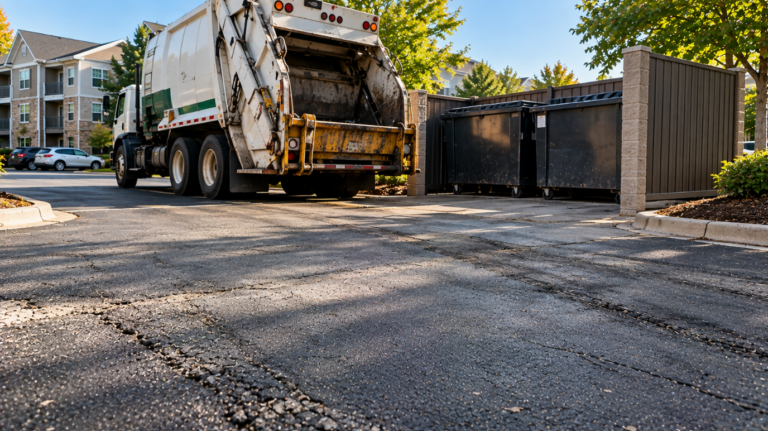
Garbage collection is such a routine part of apartment property management that it is easy to overlook what happens to the pavement every time a garbage truck enters the property. The truck follows the same route, makes many of the same turns, stops near the same dumpster, and leaves along the same path week after week.
For asphalt, that repeated pattern matters.
Apartment parking lots must support passenger vehicles as well as delivery vans, moving trucks, maintenance vehicles, emergency equipment, and garbage trucks. Areas regularly traveled by heavy vehicles can experience very different stresses than ordinary parking spaces.
Understanding garbage truck asphalt damage can help property managers identify vulnerable areas, plan repairs, and determine whether dumpster routes need a pavement structure designed for heavier traffic.
Can Garbage Trucks Damage Apartment Parking Lots?
A common question is, can garbage trucks damage apartment parking lots?
They can contribute to pavement deterioration, particularly when the asphalt or underlying base was not designed for repeated heavy vehicle traffic.
Weight is only part of the issue. Garbage trucks repeatedly travel the same route through an apartment community. They also stop, turn, reverse, and maneuver around dumpster enclosures.
These movements concentrate stress in predictable areas.
Over time, apartment parking lot heavy vehicle damage may appear as cracking, rutting, depressions, broken pavement edges, potholes, or distorted asphalt.
Damage is often most noticeable along the route leading to the dumpster and immediately around the collection area.
Why Does Pavement Fail Near Dumpsters?
Property managers frequently ask, why does pavement fail near dumpsters?
Dumpster areas combine several difficult pavement conditions.
Garbage trucks approach slowly, stop, maneuver into position, collect the dumpster, and accelerate away. Depending on the property layout, the truck may also need to make sharp turns or repeatedly reverse.
That creates more complex pavement stresses than vehicles traveling straight through a parking lot.
The same wheel paths receive these loads repeatedly. If the pavement structure is insufficient, small cracks or depressions can eventually become larger failures.
Dumpster areas can also experience drainage problems, debris, and liquids that make pavement maintenance more challenging.
Turning Creates Additional Asphalt Stress
A heavy vehicle traveling in a straight line primarily places downward loads on the pavement. When the vehicle turns, additional lateral forces are introduced.
Tires can push and scrub against the pavement surface as the truck changes direction.
This is particularly important near dumpster enclosures, where drivers often have limited maneuvering space. A garbage truck may need to make several steering adjustments before it can reach the container.
Repeated turning can contribute to surface distortion and cracking, especially during warmer weather when asphalt is more flexible.
Property managers should therefore inspect not only the dumpster pad itself but also the corners and turning areas used to reach it.
The Pavement Base Plays a Major Role
Visible asphalt is only the upper portion of a pavement system.
Underneath it is an aggregate base supported by the subgrade. These layers distribute vehicle loads and provide the foundation for the asphalt surface.
If the base is too weak for repeated heavy traffic, the pavement can begin moving under load.
Cracking, rutting, settlement, and potholes may then develop even if the asphalt surface was originally installed correctly.
Effective dumpster area pavement repair may therefore require more than placing new asphalt over the damaged area. When structural failure is present, deteriorated pavement may need to be removed so the underlying base can be evaluated and rebuilt.
Should Dumpster Routes Use Heavier Asphalt?
Another important question is, should dumpster routes use heavier asphalt?
Areas exposed to repeated heavy vehicles may require a pavement design different from areas primarily serving passenger cars.
The appropriate solution depends on the property, traffic patterns, soil conditions, base construction, drainage, and expected vehicle loads.
In some cases, heavy duty asphalt paving may be appropriate along high traffic routes. Other locations may benefit from concrete in areas where heavy vehicles repeatedly stop, load, or maneuver.
Dumpster pads are commonly treated differently from ordinary parking areas because they experience concentrated loads and repeated service vehicle traffic.
The important point is that pavement should be designed for how the property is actually used.
Watch for Early Signs of Heavy Vehicle Damage
Property managers should pay particular attention to the route garbage trucks take through the community.
Early warning signs may include cracks forming in wheel paths, shallow depressions, rutting, broken edges, loose aggregate, or repeated failure around previous patches.
Standing water is another warning sign.
If heavy traffic causes pavement to settle, water may begin collecting in the depression. Moisture can then enter cracks and affect the underlying pavement structure, contributing to further deterioration.
Including dumpster routes in routine property manager asphalt maintenance inspections makes it easier to identify these conditions before they spread.
Repeated Patching May Signal a Deeper Problem
Patching is useful for many localized pavement failures, but a section that repeatedly fails deserves closer evaluation.
If the same area near a dumpster has been repaired multiple times, the problem may extend below the asphalt surface.
A weak base, poor drainage, inadequate pavement structure, or repeated heavy loading could be contributing to the failure.
Simply adding another surface patch may not provide a lasting solution.
A contractor can evaluate the pavement to determine whether a full depth repair is necessary. That process may involve removing the failed asphalt, correcting the base, and rebuilding the pavement section for the traffic it receives.
Drainage Should Be Evaluated at the Same Time
Heavy vehicle traffic and water can be a particularly damaging combination.
Dumpster areas may be located near curbs, retaining walls, buildings, or low sections of a property where drainage is already challenging.
If water collects around damaged pavement, it can enter cracks and reach the base.
When planning dumpster area pavement repair, property managers should determine whether grading or drainage contributed to the failure.
Correcting the pavement without addressing an underlying water problem can allow deterioration to return.
Plan Dumpster Routes During Larger Paving Projects
A major resurfacing or reconstruction project is an opportunity to think about garbage truck traffic before new pavement is installed.
Property managers and paving contractors can identify where trucks enter, which turns they make, where they stop, and how they exit.
Those traffic patterns can then be considered when determining pavement structure and repair priorities.
This approach allows heavy duty asphalt paving or other appropriate materials to be concentrated where they are actually needed rather than treating every section of the parking lot identically.
It can also help property managers plan a more effective long term maintenance strategy.
Make Heavy Traffic Part of Your Pavement Maintenance Plan
Apartment parking lots experience different levels of stress depending on where vehicles travel. Ordinary parking spaces may see relatively light use, while dumpster routes can support repeated heavy truck traffic every week.
That difference should be reflected in property manager asphalt maintenance.
Regular inspections should specifically include dumpster approaches, turning areas, pavement edges, truck wheel paths, and the area immediately surrounding the enclosure.
Finding deterioration early can make it easier to plan targeted repairs before a small problem becomes a larger structural failure.
Repeated garbage truck traffic is an unavoidable part of operating an apartment community, but premature pavement failure does not have to be ignored. If your dumpster routes are cracking, rutting, settling, or requiring repeated repairs, Vandalia Blacktop & Sealcoating Inc. can evaluate the pavement and recommend an appropriate solution. From localized dumpster area pavement repair to heavy duty paving improvements, contact us to get started.