Winter weather creates challenges for commercial property owners and managers. Snow, freezing rain, and ice can make parking lots, sidewalks, and entrances difficult to navigate, making snow removal and deicing essential parts of seasonal property maintenance.
However, the way deicing materials are stored, applied, and managed can also affect the condition of asphalt pavement, concrete surfaces, and drainage systems.
For apartment communities, shopping centers, office properties, and other commercial facilities, understanding the relationship between winter maintenance and pavement deterioration can help reduce avoidable repairs.
Effective commercial pavement winter protection involves balancing safe access with practices that preserve the property’s paved surfaces.
Does Road Salt Damage Asphalt?
Property managers frequently ask, does road salt damage asphalt?
Road salt does not typically attack asphalt pavement in the same way that chloride-based deicers can contribute to deterioration in concrete. However, salt use can indirectly contribute to asphalt problems, particularly when the pavement already contains cracks or drainage issues.
Salt lowers the freezing point of water, helping melt ice and snow under suitable temperature conditions. The resulting water can enter existing cracks and reach the aggregate base beneath the pavement.
When temperatures change, moisture within the pavement structure may freeze and thaw, contributing to movement and deterioration.
Over time, cracking, settlement, and potholes may become more noticeable in areas with underlying weaknesses.
This is why road salt asphalt maintenance should focus on proper application, drainage, and addressing existing pavement defects before winter arrives.
Why Salt Storage Locations Matter
Commercial properties sometimes store bulk salt or other deicing materials on-site to make winter maintenance more convenient.
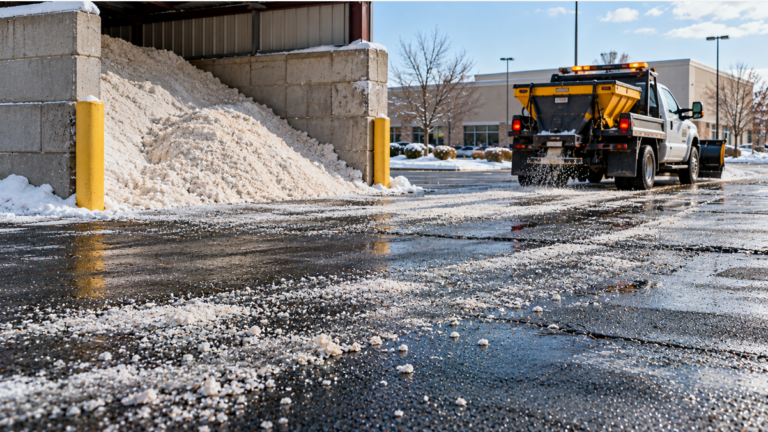
However, placing large quantities of salt directly on an asphalt parking lot can create problems.
Bulk storage areas may experience concentrated moisture, salt residue, repeated equipment traffic, and runoff carrying dissolved salts.
If the storage location already contains cracks or deteriorated pavement, water can enter the underlying materials.
Loading equipment and heavy vehicles may also place additional stress on the surface.
Whenever possible, salt should be stored in an appropriately designed, covered, and contained location that limits exposure to precipitation and prevents uncontrolled runoff.
Property managers should also consider where water from the storage area will travel during snowmelt or rainfall.
Can Deicing Products Affect Concrete Curbs and Sidewalks?
Another common question is, can deicing products affect concrete curbs and sidewalks?
Yes. Concrete can be particularly vulnerable to deterioration associated with deicing salts and repeated freezing and thawing.
Moisture enters pores within the concrete. As freezing conditions occur, expansion and repeated temperature changes can contribute to surface scaling and other deterioration.
Deicing chemicals can worsen certain forms of damage, particularly when concrete is relatively new, poorly cured, or otherwise susceptible.
Some chloride-based products can also contribute to corrosion of embedded steel reinforcement when chlorides penetrate the concrete.
This makes deicing practices especially important around sidewalks, curbs, steps, ramps, and other concrete features.
Appropriate product selection and application should account for the surface material, concrete condition, manufacturer guidance, and expected temperatures.
Excessive Salt Application Creates Additional Problems
Applying more deicing material does not automatically produce better results.
Excess salt can remain on pavement after snow and ice have melted. It may then be tracked into buildings or carried into surrounding landscaping and drainage systems.
Overapplication can also increase material costs without providing proportional improvements in winter maintenance.
For effective winter parking lot surface care, property managers should work with snow removal contractors who understand appropriate application rates and product limitations.
Different deicing materials perform differently depending on pavement temperature and weather conditions.
Using the correct material in an appropriate amount is generally more effective than applying excessive quantities without considering conditions.
Drainage Plays an Important Role in Winter Pavement Protection
Snow and ice management should always account for drainage.
When snow melts, the resulting water needs somewhere to go.
If catch basins are blocked by snow piles, ice, leaves, or debris, meltwater may collect on the pavement.
Standing water can then refreeze when temperatures drop, creating recurring icy areas.
It can also enter existing pavement cracks and contribute to deterioration beneath the asphalt.
Effective commercial pavement winter protection includes keeping drainage structures accessible and ensuring that snow storage locations do not prevent water from reaching appropriate outlets.
Property managers should pay particular attention to low areas, parking lot entrances, and locations where water regularly collects.
Snow Storage Can Affect Pavement Conditions
Snow plowing often creates large piles along parking lot edges, landscaped islands, and unused parking spaces.
The placement of these piles matters.
When snow is stored in areas with poor drainage, melting water may repeatedly flow across the same pavement sections.
Large piles can also obstruct catch basins or create visibility problems near entrances and intersections.
Property managers should establish designated snow storage areas before winter begins.
These locations should consider drainage patterns, pedestrian access, parking availability, and the condition of nearby pavement.
Planning snow storage in advance can help reduce recurring water problems and unnecessary pavement stress.
Protect Asphalt From Plow Damage
Deicing is only one part of winter maintenance.
Snowplow equipment can also affect pavement, especially where asphalt already contains potholes, raised patches, uneven joints, or broken edges.
A plow blade can catch on deteriorated pavement and cause additional damage.
Curbs, drainage structures, speed bumps, and other features may also be vulnerable if operators cannot clearly identify their locations beneath snow.
Property managers can reduce these risks by inspecting pavement before winter and marking features that may be difficult to see.
Repairing significant pavement defects before snow removal begins can also help prevent existing problems from becoming worse.
Inspect High Traffic Areas After Winter
Some areas of commercial parking lots experience greater winter stress than others.
Entrances, intersections, loading zones, dumpster routes, and heavily traveled drive lanes often receive repeated vehicle loads while also being exposed to snow removal and deicing.
These locations deserve additional attention during spring pavement inspections.
Property managers should look for new cracks, potholes, settlement, damaged edges, deteriorated concrete, and drainage problems.
If damage appears repeatedly in the same location, the underlying cause should be evaluated before repairs are performed.
A professional inspection can help distinguish surface deterioration from structural problems requiring more extensive work.
Include Deicing Practices in Your Maintenance Plan
A comprehensive Ohio parking lot maintenance program should address both summer and winter pavement conditions.
Before winter, property managers can inspect asphalt and concrete, identify drainage concerns, coordinate snow removal procedures, and review deicing material storage.
During winter, maintenance crews should monitor application practices, snow pile locations, and areas where meltwater repeatedly collects.
After winter, another inspection can identify pavement deterioration that may need attention during the warmer paving season.
Keeping records of recurring problems can also help property managers make better decisions about future repairs and capital improvements.
Balance Winter Safety With Long Term Pavement Care
Winter maintenance is necessary for commercial properties, but it should be approached as part of a broader pavement management strategy.
Proper salt storage, appropriate deicing applications, effective drainage, and careful snow removal can help reduce unnecessary stress on asphalt and concrete surfaces.
The goal is not to eliminate deicing products. It is to use them responsibly while addressing the pavement conditions that make winter damage more likely.
For apartment communities and commercial facilities, proactive winter parking lot surface care can help preserve pavement condition and reduce the likelihood of larger repair projects.
If your property is experiencing cracking, potholes, damaged curbs, drainage problems, or other pavement deterioration following winter weather, Vandalia Blacktop & Sealcoating Inc. can evaluate the affected areas and recommend appropriate asphalt or concrete repairs. For professional Ohio parking lot maintenance and pavement improvements, contact us to get started.