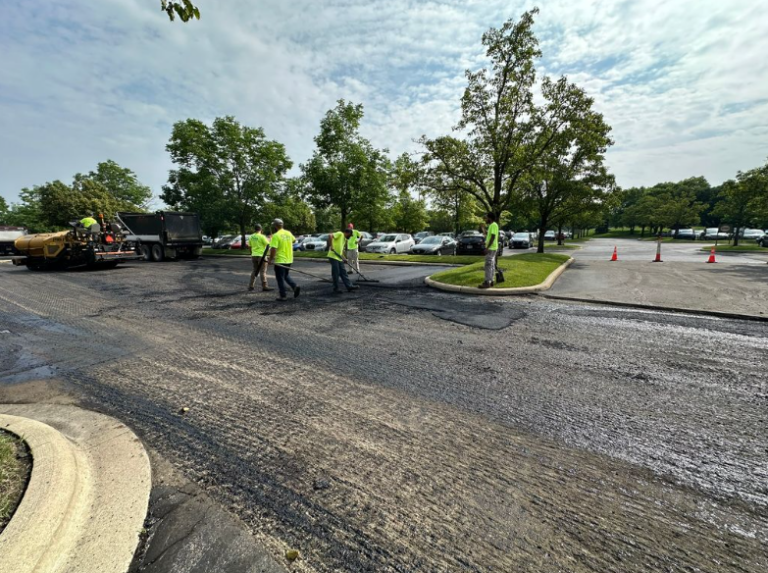
Warehouse and industrial lots need pavement built for weight and repetition: a well-prepared, stable base, a thicker asphalt section where trucks travel, and concrete in the spots where heavy loads sit still or turn hard. Forklifts and semi trucks punish pavement in different ways, so the best industrial lots are designed zone by zone instead of paved as one uniform surface.
Around Dayton and Vandalia, many distribution buildings and light industrial sites sit close to the interstates and the airport, and their lots see traffic most retail centers never will. If your loading area is rutting, cracking or breaking apart at the dock, the cause is usually a mismatch between how the pavement was built and how it is actually used.
How Semi Trucks and Forklifts Damage Pavement
A loaded tractor-trailer concentrates a great deal of weight on its axles, and that load presses down through the asphalt into the base and subgrade. When the layers underneath are not strong enough, the pavement flexes with every pass. Over time that flexing shows up as alligator cracking, ruts in the wheel paths and soft spots that turn into potholes.
Forklifts cause a different kind of wear. Their small, hard tires put intense pressure on a tiny contact area, and operators pivot and brake in the same few square feet all day. That twisting action scuffs, gouges and loosens the surface, especially when asphalt is warm in summer.
The slowest traffic is often the hardest on asphalt. A truck creeping up to a dock or sitting with its brakes set loads the pavement for a long time, which is why damage tends to cluster at docks, gates and scale or guard shack approaches rather than along open drive lanes.
Building the Right Foundation
Heavy traffic lots succeed or fail below the surface. Before any asphalt goes down, the subgrade should be evaluated, soft or unsuitable soils corrected, and a compacted aggregate base installed to spread the load. Where native soils are weak or wet, drainage and site preparation, including soil stabilization, can make the difference between a lot that lasts and one that keeps failing in the same places.
Thickness matters too. Truck lanes and loading areas generally need a heavier asphalt section than employee parking, and a qualified contractor or engineer should size it based on the vehicles you actually run. For a deeper look at how thickness drives lifespan, see our article on choosing asphalt thickness for heavy traffic areas.
Why Drainage Belongs in the Plan
Water weakens the base, and a weak base cannot carry trucks. Industrial lots are often large and flat, so ponding is common unless slopes, catch basins and outlets are planned carefully. Fixing drainage during construction costs far less than chasing the same failures for years afterward.
Where Concrete Makes Sense
Asphalt is a flexible pavement, and that flexibility is part of why it works so well for drive lanes and parking. It is less forgiving where heavy loads sit in one place or where trailers rest on their landing gear. Those spots are good candidates for concrete.
- Loading dock aprons: trucks back in, stop and sit while forklifts run in and out of the trailer.
- Trailer parking and drop lots: landing gear feet can punch into asphalt, especially in hot weather.
- Dumpster and compactor pads: heavy waste trucks lift and set containers in the same spot every week.
- Tight turning areas: places where trucks pivot sharply put twisting forces on the surface.
Many industrial sites end up with a mix: asphalt for drive lanes and employee parking, concrete pads at the docks. That combination usually balances cost and durability better than either material alone.
Designing Traffic Flow for Trucks and People
Good industrial lot design keeps trucks and passenger vehicles apart as much as the site allows. Separate entrances or clearly marked truck routes reduce conflicts, and they also concentrate heavy loads on pavement that was built to handle them.
Turning radius is a common problem. When trucks cannot make a turn cleanly, drivers cut corners and roll over edges that were never built to carry them. Wider corners protect both the pavement and the building.
Clear striping and pavement markings do a lot of work here: directional arrows, stop bars, crosswalks, no-parking zones in fire lanes and marked pedestrian paths from employee parking to the door. Requirements for fire lanes and accessible parking vary, so confirm the details with your city or township and fire department before striping.
Maintaining a Heavy-Use Lot
Industrial pavement takes a beating, so maintenance should be planned rather than reactive. A simple walk-through each spring and fall will catch most problems while they are still small.
- Seal cracks early. Open cracks let water into the base, and trucks pump that water around until the base fails. Crack sealing is typically done spring through fall when cracks are clean and dry.
- Repair failed areas properly. Alligator cracking and soft spots usually mean the base has given out. Cutting out and replacing those sections with hot mix asphalt fixes the problem; surface patches over a failed base do not last.
- Sealcoat drive lanes and parking. Sealcoating protects asphalt from water, sun and fluid spills. It needs dry pavement, temperatures around 50 degrees F and rising, and a dry forecast, so it is scheduled from late spring through early fall.
- Restripe as markings fade. Heavy truck tires wear paint quickly, and faded markings invite the kind of driving that damages pavement.
- Keep drains clear. Pallet debris, shrink wrap and sediment clog catch basins and cause ponding.
Timing matters for bigger repairs. Hot mix asphalt plants in our region close from about mid-December to mid-April, so paving and full-depth patching are planned for the warmer months. Winter potholes can be filled with cold patch to keep traffic moving, but those repairs are temporary until hot mix is available.
Planning Work Around Operations
Most warehouses cannot shut down for paving, so phasing is part of the job. Work can often be split into sections, with docks and truck routes scheduled around shipping windows and slow periods. Early conversations about receiving schedules, weekend availability and temporary truck routes help the project run smoothly.
For larger projects, fall is a good time to walk the lot with a contractor and get on the schedule for the coming season, so work can start once plants reopen in spring.
Frequently Asked Questions
Is asphalt strong enough for semi truck traffic?
Yes, when it is built for it. A properly prepared base, good drainage and an asphalt section sized for truck loads will handle semi traffic well. Problems usually come from lots that were designed for cars and later put into truck service.
Why does my loading dock area keep breaking up?
Docks combine slow, heavy truck loads with constant forklift turning, often over asphalt that sits in the shade and stays damp. Many owners solve recurring dock failures by replacing that area with a concrete apron.
Can you pave while the warehouse stays open?
In most cases, yes. Projects can be phased so part of the lot stays open, with work in truck areas scheduled around shipping and receiving hours.
When should an industrial lot be sealcoated?
Sealcoating is done when the pavement is dry, the forecast is clear and temperatures are around 50 degrees F and rising. In Ohio that generally means late spring through early fall.
Vandalia Blacktop & Sealcoating has been paving and maintaining lots across the Miami Valley since 1975, including commercial asphalt projects for sites with heavy truck traffic. If your warehouse or industrial lot is showing ruts, cracks or dock failures, contact us or call (937) 454-0571 to set up an evaluation and plan the right repairs for the coming season.