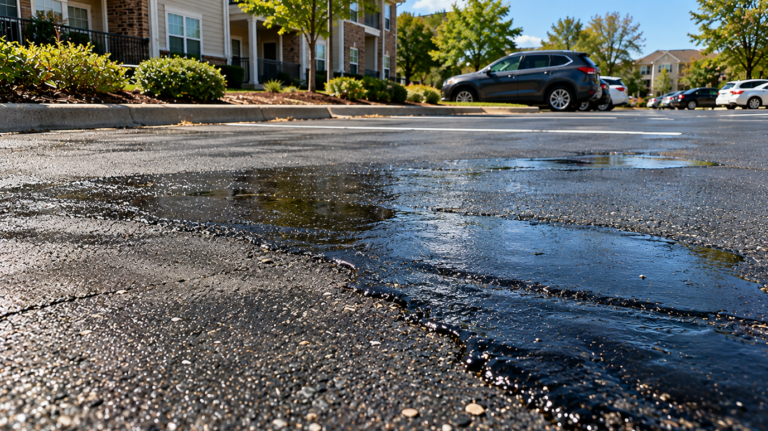
A commercial parking lot should have a relatively consistent pavement surface, but property managers sometimes notice unusually dark, glossy, or sticky areas developing in certain locations. These spots may appear along vehicle wheel paths, near intersections, or in sections exposed to heavy traffic.
Although the pavement may look freshly coated, the shiny appearance can indicate a condition known as asphalt bleeding or flushing.
Asphalt bleeding occurs when excess asphalt binder accumulates at the pavement surface, reducing the amount of exposed aggregate. Depending on the severity, this can affect pavement texture, traction, and long term performance.
Understanding the causes of asphalt flushing problems can help property managers recognize potential issues and determine when professional repairs are necessary.
Why Does Asphalt Look Shiny or Sticky?
One of the most common questions is, why does asphalt look shiny or sticky?
Asphalt pavement contains a mixture of aggregate materials and asphalt binder. The aggregate provides much of the pavement’s structure and surface texture, while the binder holds the materials together.
When excess binder moves toward or accumulates on the surface, the pavement can develop a smooth, dark, glossy appearance.
This condition is commonly called bleeding or flushing.
In severe cases, the surface may become sticky during warm weather, particularly when temperatures rise and the binder becomes softer.
A shiny asphalt parking lot does not automatically indicate a problem, especially if the pavement was recently installed or sealcoated. However, localized glossy areas that develop over time may warrant closer inspection.
What Causes Asphalt Bleeding?
Several factors can contribute to asphalt bleeding.
One possible cause is excessive asphalt binder within the pavement mixture. If the mixture contains more binder than the aggregate structure can accommodate, traffic and warm temperatures may contribute to binder accumulating at the surface.
Insufficient air voids within the compacted pavement can also contribute to the problem.
As vehicles repeatedly travel across the asphalt, additional compaction may reduce the available space within the pavement mixture.
When binder has insufficient room within the aggregate structure, it may migrate toward the surface.
These conditions can produce an excess asphalt binder surface that appears unusually dark or glossy.
Heavy Traffic Can Make Bleeding More Noticeable
Commercial parking lots experience different levels of traffic depending on their layout.
Entrances, intersections, loading zones, and heavily traveled drive lanes may receive repeated vehicle loads throughout the day.
These concentrated loads can contribute to additional pavement densification, particularly when the asphalt mixture is susceptible to bleeding.
As a result, shiny areas may develop in predictable wheel paths while nearby parking spaces retain a more textured appearance.
For apartment communities and commercial properties, this can explain why certain sections develop commercial pavement surface defects before surrounding areas show similar symptoms.
Warm Weather Can Make the Problem Worse
Temperature plays an important role in asphalt performance.
During hot weather, asphalt binder becomes softer and more flexible. If excess binder is already present near the surface, higher temperatures may make the glossy appearance more noticeable.
In severe cases, the pavement can become tacky enough for material to adhere to vehicle tires or shoes.
This is different from ordinary asphalt softening during summer weather.
Persistent bleeding indicates that the pavement surface may contain more binder than is appropriate for the available aggregate texture.
Property managers should pay particular attention to areas that become unusually shiny or sticky during periods of high temperatures.
Is Asphalt Bleeding a Safety Concern?
Another important question is, is asphalt bleeding a safety concern?
It can be.
A properly constructed asphalt surface contains exposed aggregate that helps provide traction for vehicle tires.
When excess binder covers that aggregate, the pavement may lose some of its surface texture.
Reduced texture can affect tire grip, particularly during wet conditions.
The severity of the concern depends on how much binder has accumulated, the location of the affected pavement, and the traffic using the area.
Bleeding near entrances, intersections, pedestrian crossings, or turning areas may deserve particular attention because vehicles frequently brake or change direction in these locations.
A professional assessment can help determine whether asphalt bleeding repair is necessary.
Bleeding Is Different From Sealcoating
Property managers sometimes confuse asphalt bleeding with the appearance of a recently sealcoated parking lot.
Sealcoating is a maintenance treatment applied to the pavement surface. It typically creates a darker, more uniform appearance when properly installed.
Bleeding, however, involves asphalt binder accumulating at the pavement surface.
The two conditions may appear similar at first glance, but their causes and appropriate treatments are different.
A parking lot with localized glossy wheel paths may be experiencing bleeding, while a uniformly dark surface following maintenance may simply reflect a recent sealcoat application.
If the pavement becomes unusually sticky or develops slick areas, further evaluation is appropriate.
Can Asphalt Bleeding Be Repaired?
In many situations, yes.
The appropriate asphalt bleeding repair depends on the severity of the condition and whether the problem is limited to the surface.
Minor bleeding may sometimes be addressed through specialized surface treatments designed to restore texture or manage excess binder.
More severe cases may require removal of the affected surface layer and replacement with properly designed asphalt.
If bleeding is associated with broader pavement problems, the contractor may need to evaluate the asphalt mixture, pavement structure, and traffic conditions before recommending repairs.
Simply applying another surface coating is not necessarily an appropriate solution.
The goal is to restore a functional pavement surface while addressing the underlying cause.
Why Proper Asphalt Mixture Design Matters
Asphalt performance begins with selecting an appropriate mixture for the intended application.
The relationship between aggregate, binder content, and air voids influences how pavement responds to traffic and temperature changes.
Too little binder can contribute to durability problems, while excessive binder or insufficient air voids can increase susceptibility to bleeding.
Proper production, placement, and compaction are also important.
Commercial pavement should be designed and constructed with expected traffic loads and operating conditions in mind.
Areas supporting frequent heavy vehicles may require different considerations than ordinary passenger vehicle parking spaces.
Inspect Shiny Areas Before They Spread
Property managers should include unusual pavement discoloration and texture changes in routine parking lot inspections.
Look for glossy wheel paths, sticky surface areas, smooth patches with limited visible aggregate, and locations where tires appear to leave unusual marks.
It is also useful to document whether the condition becomes more noticeable during warm weather.
Photographs and maintenance records can help contractors understand when the problem developed and whether it is changing.
Early identification of asphalt flushing problems allows property managers to evaluate the affected pavement before the condition becomes more extensive.
Not Every Dark Spot Indicates Bleeding
A dark patch on asphalt can have several possible explanations.
Fresh repairs, sealcoating, vehicle fluid leaks, and variations in pavement materials may all create areas that look different from the surrounding surface.
That is why visual appearance alone may not be enough to diagnose the problem.
A contractor can evaluate the pavement texture, surface condition, and location of the discoloration to determine whether bleeding is occurring.
Correct identification is important because the repair method for excess binder is different from the treatment needed for an oil stain, failed patch, or ordinary surface wear.
Protect Commercial Pavement Through Proper Maintenance
Parking lot maintenance should involve more than repairing potholes and sealing cracks.
Surface texture, drainage, traffic patterns, and unusual pavement conditions can also provide valuable information about asphalt performance.
For apartment communities, retail centers, office properties, and other commercial facilities, regular inspections can help identify commercial pavement surface defects before they create larger concerns.
If your parking lot has developed shiny black spots, sticky pavement, or smooth areas that appear to be losing traction, Vandalia Blacktop & Sealcoating Inc. can evaluate the surface and recommend an appropriate solution. From targeted asphalt bleeding repair to larger commercial pavement improvements, contact us to get started.