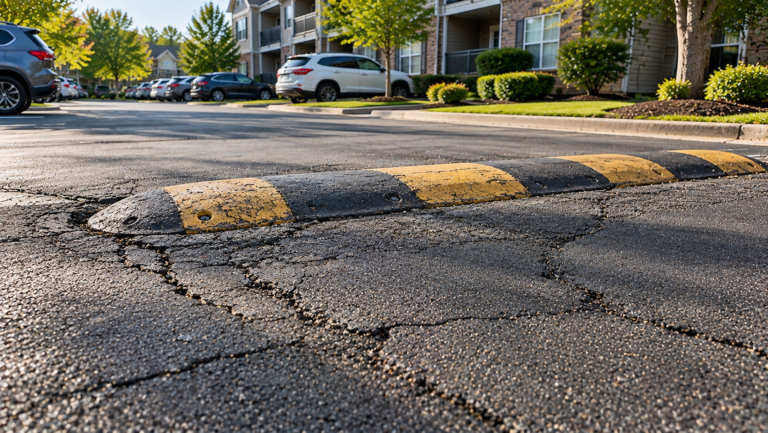
Speed bumps and speed humps can help slow vehicles through apartment communities, especially in areas with frequent pedestrian activity. However, property managers may notice something unusual after years of use: the pavement immediately around a speed bump can begin cracking or deteriorating even while nearby asphalt remains in relatively good condition.
This damage is not necessarily caused by the speed bump alone. Vehicle braking, acceleration, concentrated wheel loads, water infiltration, installation methods, and the condition of the underlying pavement can all contribute to problems around traffic calming features.
Understanding why apartment parking lot speed bumps become trouble spots can help property managers recognize early deterioration and determine when repairs are necessary.
Why Does Asphalt Crack Around Speed Bumps?
One of the most common questions is, why does asphalt crack around speed bumps?
Traffic behaves differently around a speed bump than it does on an ordinary drive lane. Drivers typically brake before reaching the bump, cross it slowly, and then accelerate afterward.
That creates repeated changes in the forces being placed on the pavement.
Instead of vehicles simply rolling across the asphalt at a steady speed, the pavement around the speed bump experiences braking, acceleration, and concentrated loads in roughly the same locations throughout the day.
At an apartment community with dozens or hundreds of vehicles entering and leaving regularly, those repeated movements add up.
Eventually, pavement cracking near speed humps may appear in the areas receiving the greatest stress.
Heavy Vehicles Increase Pavement Stress
Passenger vehicles are only part of the traffic moving through an apartment community.
Parking lots also need to accommodate:
- Garbage trucks
- Delivery vehicles
- Moving trucks
- Maintenance vehicles
- Emergency vehicles
- Landscaping equipment
- Utility vehicles
These heavier vehicles place greater loads on pavement, particularly when they slow down and accelerate around speed bumps.
If a traffic calming feature is located along a route frequently used by commercial vehicles, the surrounding pavement may experience substantially more stress than an ordinary parking area.
This is one reason speed bump locations should receive special attention during routine pavement inspections.
Water Can Collect Around Speed Bumps
Drainage is another important factor.
Speed bumps and speed humps change the profile of the pavement surface. If they are poorly positioned or installed without considering drainage, water may collect along one side.
Standing water creates more than an inconvenience.
If cracks develop around the traffic calming feature, water can enter the pavement structure and reach the aggregate base. Saturated supporting material can become less stable, increasing the likelihood of settlement and additional cracking.
In Ohio, moisture entering pavement can create additional problems during seasonal freezing and thawing.
Proper drainage is therefore an important consideration for both asphalt traffic calming installations and repairs.
Installation Can Affect Pavement Performance
Not every speed bump is installed the same way.
Some are constructed from asphalt as a permanent part of the pavement. Others are prefabricated units attached to an existing parking lot.
Regardless of the type, installation should consider the condition of the pavement beneath and around the traffic calming feature.
Installing a speed bump over asphalt that already has structural problems does not correct those problems. Existing cracking, settlement, or weak base materials may continue deteriorating after installation.
Attachment points for prefabricated systems also need to be installed correctly to avoid unnecessary pavement damage.
How Should Speed Bumps Be Installed Without Damaging Asphalt?
Property managers may ask, how should speed bumps be installed without damaging asphalt?
The first step is evaluating the existing pavement.
Before adding a traffic calming feature, the asphalt should be checked for cracking, settlement, drainage issues, and structural deterioration. Installing a speed bump over failing pavement can make future repairs more complicated.
The location should also be selected with traffic flow and drainage in mind.
Important considerations include:
- Existing pavement condition
- Drainage patterns
- Vehicle types
- Traffic volume
- Emergency access
- Pedestrian activity
- Visibility
- Manufacturer requirements for prefabricated systems
Professional installation helps ensure the feature serves its intended purpose without unnecessarily compromising surrounding pavement.
Braking and Acceleration Create Predictable Wear Areas
Property managers can often learn something from where the damage appears.
Cracking before the speed bump may indicate stress where drivers repeatedly brake. Damage immediately after the bump may occur where vehicles accelerate.
Wheel path depressions can indicate repeated loading or weakness within the pavement structure.
Recognizing these patterns can help a contractor determine whether the problem is primarily surface deterioration or whether deeper structural repair may be required.
This diagnostic approach is important when planning multifamily parking lot repair.
Can Damaged Pavement Around a Speed Bump Be Repaired?
Yes. Property managers frequently ask, can damaged pavement around a speed bump be repaired?
The appropriate solution depends on the severity and cause of the deterioration.
Minor cracking may require relatively limited maintenance when the surrounding pavement remains structurally sound. More significant damage may require removal and replacement of the affected asphalt.
Possible asphalt repair around speed bumps can include crack repair, localized patching, removal and replacement of deteriorated pavement, base repair, or drainage correction.
If the speed bump itself is contributing to drainage or pavement problems, it may need to be temporarily removed or reconstructed as part of the project.
The goal should be to address the cause rather than simply cover visible cracks.
Do Not Ignore Settlement
A depression around a speed bump deserves particular attention.
Settlement may indicate that the aggregate base or subgrade beneath the asphalt has weakened or compressed.
Adding surface asphalt to a depression without addressing an unstable foundation may only provide temporary improvement.
A contractor may need to remove the affected pavement and evaluate the supporting materials before rebuilding the area.
For apartment communities, identifying these structural problems early can help prevent deterioration from spreading into surrounding drive lanes.
Include Speed Bumps in Routine Pavement Inspections
Traffic calming areas should be specifically examined during parking lot inspections.
Property managers should look for cracking along the edges of the speed bump, depressions in vehicle wheel paths, loose asphalt, standing water, potholes, damaged attachment points, and changes in the shape of the pavement.
These areas can deteriorate differently from the rest of the parking lot because of their unique traffic patterns.
Early identification can make multifamily parking lot repair easier to plan and potentially limit the amount of pavement requiring reconstruction.
Think About the Entire Traffic Pattern
Speed bumps are only one component of a larger parking lot system.
Their performance is influenced by entrances, intersections, parking spaces, pedestrian routes, drainage systems, and the types of vehicles using the property.
Effective asphalt traffic calming should therefore be considered as part of overall parking lot planning rather than as an isolated feature.
A well planned layout can slow vehicles while maintaining reasonable traffic flow, drainage, and pavement performance.
Protect High Stress Areas Before Problems Spread
Speed bumps serve an important purpose in many apartment communities, but the pavement around them experiences unusual stresses. Repeated braking, acceleration, heavy vehicle traffic, drainage problems, and existing pavement weaknesses can all contribute to premature deterioration.
Regular inspections help property managers identify pavement cracking near speed humps before minor damage develops into a larger repair. When problems do appear, determining the underlying cause is essential to choosing a lasting solution.
If the pavement around your apartment community’s speed bumps is cracking, sinking, collecting water, or developing potholes, Vandalia Blacktop & Sealcoating Inc. can evaluate the affected areas and recommend an appropriate repair strategy. From targeted asphalt repair around speed bumps to larger apartment parking lot improvements, contact us to get started.