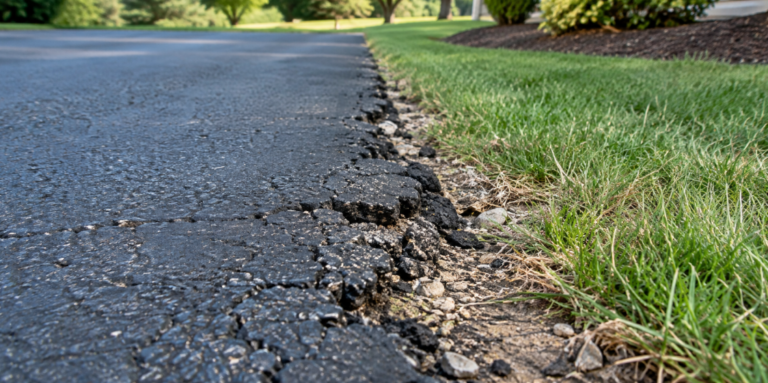
The center of an asphalt driveway or parking lot often receives the most attention, but some of the first signs of pavement failure frequently appear along the edges. Crumbling asphalt, broken corners, widening cracks, and sections that appear to sink can gradually work inward, turning a relatively small problem into a much larger repair.
Asphalt edges are particularly vulnerable because they do not always have the same lateral support as pavement surrounded by curbs or other structures. Vehicle traffic, poor drainage, weak base material, and erosion can place additional stress on these exposed areas.
Understanding what causes edge deterioration and investing in timely asphalt edge repair can help homeowners and property managers prevent damage from spreading while extending the useful life of their pavement.
Why Are the Edges of My Asphalt Driveway Crumbling?
Homeowners frequently ask, why are the edges of my asphalt driveway crumbling?
There is rarely a single cause. Instead, edge failure commonly develops from a combination of structural and environmental factors.
One major issue is inadequate support. Asphalt performs best when the pavement structure beneath and beside it provides stability. If the aggregate base does not extend far enough beyond the asphalt or the soil beside the driveway erodes, the pavement edge can lose support.
Vehicle traffic can make the problem worse. Tires that repeatedly travel along or beyond the pavement edge apply loads to an area with less support than the center of the driveway.
Over time, crumbling asphalt driveway edges may begin as small cracks or broken pieces and gradually spread farther into the pavement.
Water Can Accelerate Edge Deterioration
Drainage is another major factor in pavement performance.
Rainwater that repeatedly flows along the side of a driveway or parking lot can erode soil and aggregate supporting the asphalt. Once this supporting material disappears, the pavement becomes more susceptible to cracking and breaking under vehicle loads.
Water can also enter cracks along the edge and reach the underlying pavement structure. During Ohio’s colder months, repeated freezing and thawing can contribute to additional movement and deterioration.
Proper grading and drainage should therefore be considered an important part of both pavement installation and ongoing maintenance.
Vehicle Traffic Matters
Asphalt pavement is designed to support traffic, but where vehicles travel matters.
Drivers who repeatedly allow tires to leave the paved surface can place additional pressure on unsupported edges. This is particularly common on narrow residential driveways where two vehicles attempt to pass or drivers regularly turn around near the pavement boundary.
Commercial properties face similar problems. Delivery trucks, garbage trucks, maintenance vehicles, and other heavy equipment can contribute to parking lot edge deterioration, especially around loading areas and perimeter drive lanes.
Preventing unnecessary vehicle traffic directly along vulnerable edges can help reduce this stress.
How Do You Prevent Asphalt Edges From Breaking?
Another important question is, how do you prevent asphalt edges from breaking?
Prevention begins during construction. A properly prepared and compacted aggregate base provides the structural foundation needed to support the asphalt. The pavement should also be designed for the type and volume of traffic expected on the property.
After installation, property owners can protect edges by maintaining the surrounding shoulder and correcting erosion before it removes essential support.
Effective asphalt edge reinforcement may involve properly compacted aggregate along exposed pavement edges, appropriate grading, curbing in suitable commercial applications, or other site specific solutions.
Property owners should also keep heavy vehicles away from unsupported edges whenever possible.
The Importance of Proper Base Preparation
Asphalt is only one component of a pavement system. Beneath the visible surface is a foundation that plays a major role in determining how well the pavement handles traffic.
If the base is poorly compacted or too narrow, edges may settle or break even when the asphalt itself was installed correctly.
Professional contractors evaluate soil conditions, drainage, anticipated vehicle loads, and the aggregate base before paving. Addressing these factors during construction can significantly reduce the likelihood of premature edge deterioration.
For homeowners planning a new driveway, proper preparation is particularly important because correcting foundation problems after asphalt has been installed can require more extensive residential driveway repair.
Can Damaged Parking Lot Edges Be Repaired?
Property managers often ask, can damaged parking lot edges be repaired?
Yes, depending on the extent and underlying cause of the damage.
Minor deterioration may sometimes be addressed before it spreads. More extensive failures can require removal of damaged asphalt, correction of the underlying base, and installation of new pavement.
Simply placing material over a failing edge without correcting erosion, drainage, or base problems may provide only a temporary improvement.
Professional asphalt edge repair should address both the visible damage and the reason the pavement failed.
Watch for Early Warning Signs
Edge problems are generally easier to manage when they are discovered early.
Homeowners and property managers should periodically inspect pavement for crumbling, cracks running parallel to the edge, missing aggregate, erosion, settlement, or areas where vehicles frequently leave the pavement.
Apartment communities and commercial properties should pay particular attention to perimeter drive lanes, dumpster areas, loading zones, and entrances where larger vehicles make frequent turns.
Regular inspections make it easier to identify parking lot edge deterioration before it spreads into traffic lanes or parking areas.
Parking Lots May Benefit From Concrete Curbs
Commercial parking lots and apartment communities often have options that are less practical for residential driveways.
Concrete curbs can provide a defined pavement boundary while helping control traffic and direct stormwater. Properly designed curbing may also help protect landscaping and discourage vehicles from driving beyond designated pavement areas.
Curbs are not the right solution for every property, particularly where drainage requirements call for different designs, but they can be incorporated into larger parking lot improvement projects where appropriate.
Maintenance Protects the Entire Pavement
Protecting asphalt edges should be part of a broader pavement maintenance strategy.
Crack sealing helps reduce water infiltration. Drainage maintenance prevents water from collecting beside pavement. Prompt repairs keep localized deterioration from expanding, while regular inspections allow developing problems to be identified early.
The goal is not simply to repair visible damage. Effective pavement maintenance addresses the conditions that caused the deterioration in the first place.
This approach is valuable for homeowners as well as apartment owners and property managers responsible for large paved areas.
Professional Evaluation Can Identify the Real Cause
Two deteriorating asphalt edges may look similar while having completely different underlying problems.
One property may have inadequate base support. Another may be experiencing erosion from poor drainage. A third may have damage caused primarily by repeated heavy vehicle traffic.
An experienced asphalt contractor can evaluate the pavement, surrounding grade, drainage, base condition, and traffic patterns before recommending a repair.
This is especially important when deterioration continues returning after previous repairs. Repeated failure may indicate that the underlying structural problem has never been corrected.
Asphalt edges may occupy only a small portion of a driveway or parking lot, but their condition can have a major impact on the rest of the pavement. Proper base preparation, drainage, traffic management, routine inspections, and timely repairs can help keep edge deterioration from progressing inward. Addressing crumbling asphalt driveway edges or commercial pavement damage early can also reduce the need for more extensive repairs later.
If the edges of your driveway or parking lot are cracking, crumbling, or losing support, Vandalia Blacktop & Sealcoating Inc. can evaluate the cause and recommend an appropriate repair strategy. Contact us to get started.