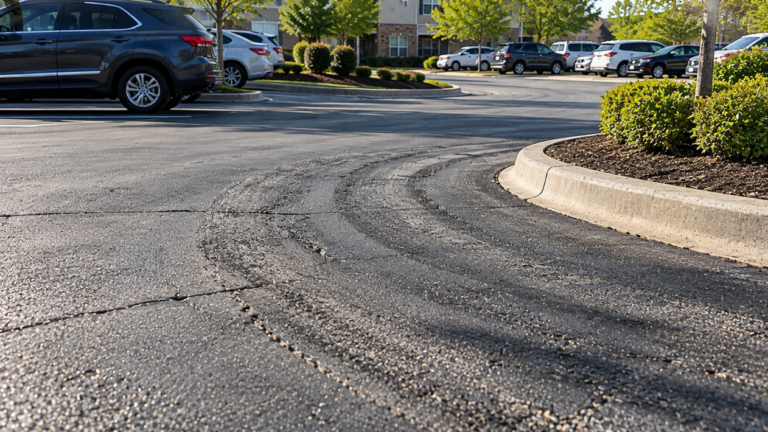
Not every part of a commercial parking lot experiences the same amount of stress. Parking spaces may primarily support stationary passenger vehicles, while straight drive lanes experience vehicles moving at relatively consistent speeds. Turning areas and tight corners face a different challenge. Vehicles slow down, accelerate, change direction, and place additional forces on the pavement every day.
For apartment communities, retail centers, office properties, schools, and other commercial facilities, these areas can begin showing wear earlier than surrounding pavement. Cracking, rutting, surface distortion, and broken pavement near curbs are all signs that repeated turning movements may be affecting the asphalt.
Understanding the causes of parking lot turning area damage can help property managers recognize trouble early and choose repairs that address the actual source of deterioration.
Why Does Asphalt Wear Faster Where Vehicles Turn?
Property managers often ask, why does asphalt wear faster where vehicles turn?
When a vehicle travels straight across pavement, most of its load is directed downward. During a turn, tires also place lateral forces on the asphalt as they change direction. Slow, sharp turns can create particularly demanding conditions.
These stresses occur repeatedly in predictable locations, including:
- Parking lot entrances
- Tight intersections
- Drive through lanes
- Dumpster areas
- Loading zones
- Parking garage approaches
- Corners around landscaped islands
Over time, repeated turning movements can contribute to commercial asphalt traffic damage, particularly when heavy vehicles regularly use the same route.
Heavy Vehicles Increase the Stress
Passenger vehicles create pavement wear, but trucks and other heavy vehicles can significantly increase the demands placed on turning areas.
Commercial parking lots may routinely accommodate garbage trucks, delivery vehicles, moving trucks, buses, emergency vehicles, and maintenance equipment.
These vehicles are not only heavier than passenger cars. They also require more space to maneuver.
A garbage truck making a tight turn around a dumpster enclosure, for example, can place significant stress on a relatively small section of pavement. If that movement occurs repeatedly every week, deterioration can become concentrated in that area.
Properties with frequent commercial vehicle traffic may therefore need specialized heavy traffic pavement repair when damage develops.
Why Are Tight Parking Lot Corners Cracking?
Another common question is, why are tight parking lot corners cracking?
Turning forces are one possible cause, but cracking can also indicate other pavement problems.
Common contributing factors include:
- Heavy traffic
- Aging asphalt
- Insufficient pavement thickness
- Weak aggregate base
- Poor drainage
- Water infiltration
- Inadequate compaction
- Edge deterioration
Tight corners can combine several of these conditions.
For example, a corner next to a landscaped island may experience frequent turning traffic while also receiving water runoff from surrounding areas. If cracking allows moisture into the pavement structure, the supporting base may weaken and accelerate deterioration.
Determining the cause is important before beginning repairs.
Tire Scrubbing Can Affect the Surface
Slow moving vehicles can create another form of pavement stress sometimes called tire scrubbing.
When tires turn sharply at low speeds, they can twist against the pavement surface instead of simply rolling across it. Heavy trucks with multiple axles can create especially significant forces during tight turns.
Over time, repeated tire movement may contribute to surface wear, aggregate loss, or distortion.
This is one reason commercial asphalt design should consider vehicle movement rather than simply the number of parking spaces on a property.
Parking Lot Geometry Matters
The layout of a parking lot can influence how much stress turning areas experience.
Narrow drive aisles, small turning radiuses, poorly positioned curbs, and tight access points may force drivers to make sharper turns.
Large commercial vehicles may have even greater difficulty navigating these spaces.
Effective parking lot design considers:
- Vehicle turning requirements
- Drive aisle widths
- Traffic direction
- Delivery routes
- Dumpster access
- Emergency vehicle access
- Parking space configuration
Improving traffic flow can reduce unnecessary turning stress while making the property easier for drivers to navigate.
How Can Parking Lots Handle Frequent Turning Traffic?
Property owners often ask, how can parking lots handle frequent turning traffic?
The solution begins with understanding which vehicles regularly use the property and where they travel.
High stress locations may benefit from:
- Appropriate pavement thickness
- Strong aggregate base construction
- Proper compaction
- Effective drainage
- Wider turning areas
- Timely pavement maintenance
In particularly demanding locations, contractors may recommend different pavement designs or materials.
Dumpster pads are a good example. Because garbage trucks repeatedly stop and maneuver in the same location, concrete is often used to provide additional resistance to concentrated heavy loads.
Water Makes Turning Area Damage Worse
Water can accelerate many forms of asphalt deterioration.
Once cracks develop, moisture may enter the pavement and reach the aggregate base. A weakened base provides less support for vehicles traveling overhead.
The combination of water and frequent turning traffic can lead to:
- Cracking
- Settlement
- Rutting
- Potholes
- Surface deformation
Drainage should therefore be evaluated whenever parking lot corner deterioration becomes noticeable.
Repairing the asphalt without correcting an underlying drainage issue may allow the damage to return.
Watch the Pavement Around Curbs and Islands
Curbs and landscaped islands naturally create turning points throughout parking lots.
These areas deserve extra attention during routine pavement inspections.
Property managers should watch for:
- Cracks following the curb
- Broken pavement edges
- Depressions in wheel paths
- Loose aggregate
- Standing water
- Surface distortion
- Potholes near corners
Finding deterioration early may allow for localized repairs before damage spreads into surrounding pavement.
Repair Strategies Depend on the Cause
There is no single repair method for every damaged turning area.
Minor surface deterioration may require a relatively limited repair. Structural damage involving the base may require full depth reconstruction.
Possible repair strategies include:
- Crack sealing
- Localized asphalt patching
- Milling and resurfacing
- Full depth pavement repair
- Base reconstruction
- Drainage improvements
Effective heavy traffic pavement repair should address why the pavement failed instead of simply covering the visible damage.
An experienced asphalt contractor can evaluate traffic patterns, pavement condition, drainage, and structural support before recommending a solution.
Preventive Maintenance Helps Protect High Stress Areas
Turning areas should be included in every commercial pavement inspection and maintenance program.
Because these locations may deteriorate faster, property managers should not assume that the condition of the average parking space represents the condition of the entire lot.
Regular inspections can identify early cracking, surface movement, and drainage problems.
Crack sealing, timely patching, drainage maintenance, and other preventive services can help keep small problems from becoming larger repairs.
Design for How the Property Is Actually Used
Long lasting pavement begins with understanding real traffic patterns.
A commercial parking lot serving mostly passenger vehicles has different needs than an apartment community with frequent garbage trucks or a retail property receiving daily tractor trailer deliveries.
Good commercial asphalt design accounts for those differences.
Entrances, loading areas, drive lanes, dumpster approaches, and tight corners may require additional consideration because they experience greater traffic stresses than ordinary parking spaces.
Designing these areas appropriately from the beginning can help reduce premature deterioration and future repair costs.
Turning areas and tight corners may occupy only a small portion of a commercial parking lot, but they often experience some of its greatest stresses. Repeated steering forces, heavy vehicles, drainage problems, and tight layouts can all contribute to parking lot turning area damage and premature deterioration.
If your commercial property or apartment community has cracking, rutting, surface distortion, or other damage in high traffic turning areas, Vandalia Blacktop & Sealcoating Inc. can evaluate the pavement and recommend an appropriate repair strategy. From localized commercial asphalt traffic damage to larger pavement restoration projects, contact us to get started.